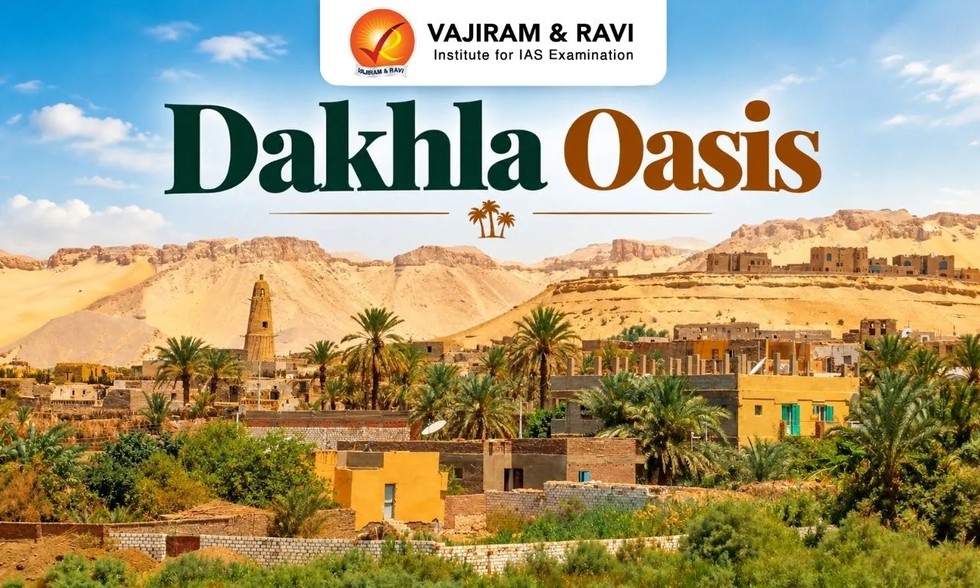
A rare pyramid-shaped tomb dating to the Roman period has been recently uncovered at Bir Al-Shaghala in Egypt’s Dakhla Oasis.
About Dakhla Oasis:
It is a desert oasis located west of the Nile River, between Cairo and Luxor in Egypt.
It is part of the Western Desert, which covers two-thirds of the land area of the country.
It is known for its rich history and stunning landscapes.
Nomadic hunter-gatherers first settled in Dakhla Oasis around 12,000 years ago.
It has long been a crossroads between different parts of North Africa.
Ancient routes passing through the region connected communities travelling betweenEgypt, the Sahara, and Libya, leaving behind evidence of repeated human activity.
Among the most valuable remains are thousands of petroglyphs carved into exposed rock surfaces.
Some depict animals that once lived in a wetter Sahara, while others show people, hunting scenes, and symbols connected to different periods of settlement.
It was only connected to the outside world by a road built in the 80s, the so-called Great Desert Loop.
The soil's exceptional fertility makes Dakhla famous. Local farmers grow dates, olives, and other crops that are the foundations of the region's agriculture.
The oasis also features therapeutic hot springs like Bir Tarfawi and Bir Al-Gebel.
Dakhla Oasis is home to several important sites, including Mut, Al-Qasr village, and the Dakhla Oasis Heritage Museum.
What is an Oasis?
An oasis is an area made fertile by a source of freshwater in an otherwise dry and arid region.
Oases (more than one oasis) are irrigated by natural springs or other underground water sources.
They vary in size from a cluster of date palms around a well or a spring to a city and its irrigated cropland.
Dates, cotton, olives, figs, citrus fruits, wheat, and corn (maize) are common oasis crops.
Underground water sources called aquifers supply most oases.
In some cases, a natural spring brings the underground water to the surface. At other oases, manmade wells tap the aquifer.
Dear Student,
You have still not entered your mailing address. Please enter the address where all the study materials will be sent to you. (If applicable).