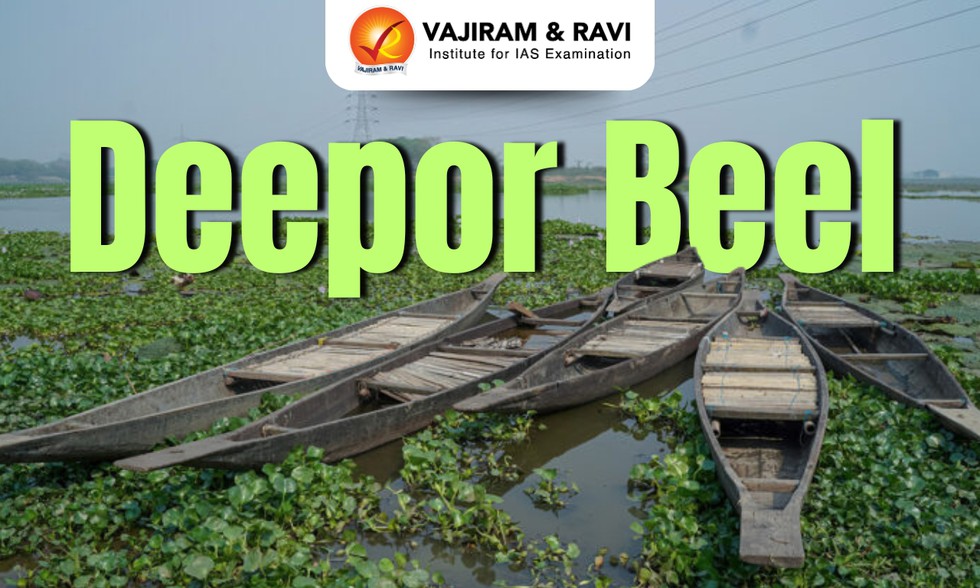
Illegal earth cutting from a wetland connected to Deepor Beel is continuing unabated in the Satmile area of Guwahati, despite prohibitory orders from the district administration and restrictions imposed by the Gauhati High Court.
About Deepor Beel:
It is a permanent freshwater lake in in Assam.
It lies in a former channel of the Brahmaputra River.
Beel is an Assamese local word which means ‘lake’, and the name Deepor Beel means the ‘lake of elephants’.
It is considered one of the biggest lakes of the Brahmaputra Valley of Lower Assam.
It is surrounded by steep highlands on the northern and southern sides, and its main sources of water are the Kalmani and Basistha Rivers.
It is the only major stormwater storage basin for the city of Guwahati.
The lake’s outflow is the Khandajan rivulet, which joins the Brahmaputra.
It is recognised as a Ramsar Site and as an Important Bird and Biodiversity Area (IBA). It is the only Ramsar site inAssam.
This lake is a staging site on migratory flyways, and some of the largest concentrations of aquatic birds in Assam can be seen, especially in winter.
Some globally threatened birds are supported, including Spot-billed Pelican, Lesser Greater Adjutant Stork, and Baer’s Pochard.
The Rani and Garbhanga hills, the habitat of the Asiatic elephants on the southern side of the beel, are part of this ecosystem.
Dear Student,
You have still not entered your mailing address. Please enter the address where all the study materials will be sent to you. (If applicable).