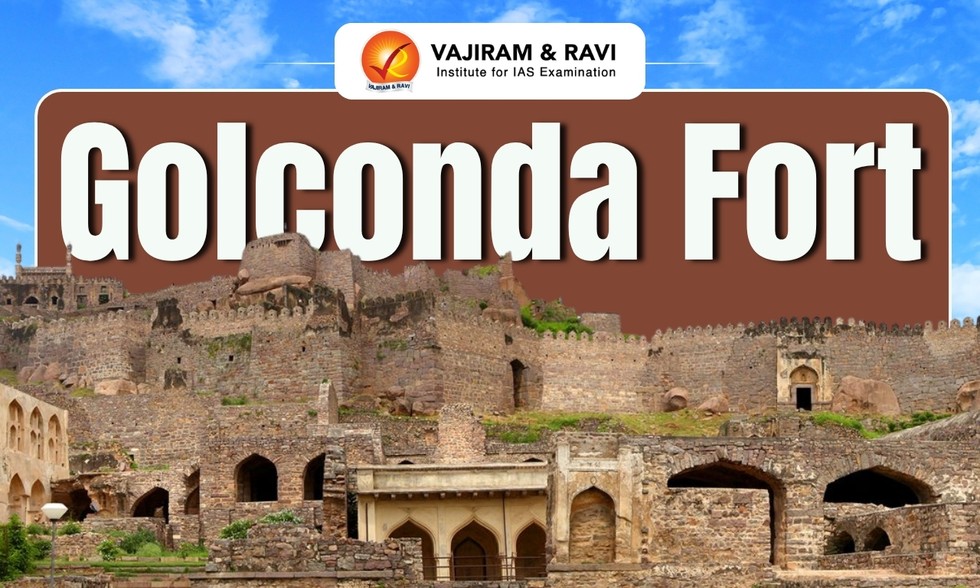
The Archaeological Survey of India (ASI) recently said a structure recently found near the historic Golconda Fort in Hyderabad is not a tunnel, as had been reported, but a small rectangular chamber made of granite stone.
About Golconda Fort:
It is a historic fort located towards the western outskirts of Hyderabad, Telangana.
The name originates from the Telugu words "Golla Konda" meaning "Shepherd's Hill".
History:
It was erected in 1143 under the Kakatiya Dynasty.
However, it rose to prominence when it came under the rule of the Qutub Shahi Dynasty during the 16th century, e., when Quli Qutub Shah declared his independence from the Bahmani Sultanate in 1518.
The striking fort has since then expanded from a mud fortress to a lofty structure with a 10 km outer wall.
From 1518 to 1591, Golconda served as the capital of the Qutb Shahi rulers before they shifted their capital to Hyderabad.
After a failed attempt in the year 1686, the Mughal emperor Aurangzeb was finally able to breach the impregnable fort in 1687 after a long nine-month siege.
After this, Golconda became part of the Mughal Empire.
Golconda region was world-famous for its diamond mines. Some of the most valuable diamonds in history, including the Koh-i-Noor, Hope Diamond, and Nassak Diamond, were once associated with this region.
Architecture:
It is a grand structure displaying the beautiful fusion of Hindu-Islamic style of architecture.
Amongst the eight gates, Fateh Darwaza is the main gate, as the victorious march of King Aurangzeb proceeded through it.
At Fateh Darwaza one can witness fantastic acoustical effects, which is one among the many famous engineering marvels at Golconda.
There are three powerful consecutive fortification walls, each within the other.
The first line of the wall contains a town; the second line is a double wall that runs around the foot of the hill on which the citadel stands.
The third line is further up the hill, lying within the second, composed of masonry and natural boulders.
The tombs of the Qutub Shahi kings, built with Islamic architecture, lie north of the outer wall of Golconda.
Situated within the fortress are the dwellings of the queens and princesses and homesteads of their retainers.
It is quite famous for its royal apartments, parade grounds, numerous halls, and mosques.
Dear Student,
You have still not entered your mailing address. Please enter the address where all the study materials will be sent to you. (If applicable).