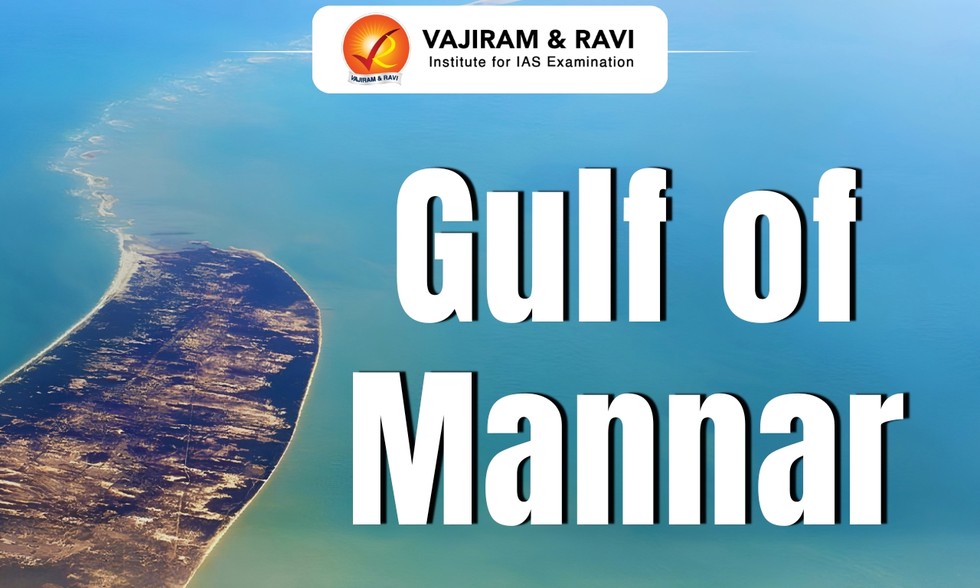
The Gulf of Mannar has witnessed a steep decline in bird numbers over the last four decades, with overall shorebird abundance dropping by nearly 57%, according to a peer-reviewed study published recently.
About Gulf of Mannar:
It is a vast shallow bay that forms part of the Laccadive Sea in the Indian Ocean.
It is located between southeastern India and western Sri Lanka.
It is bounded to the northeast by Rameswaram (island), Adam’s (Rama’s) Bridge (a chain of shoals), and Mannar Island.
It is connected to the Palk Bay in the north through the Palk Strait.
It receives several rivers, including the Tambraparni (India) and the Aruvi (Sri Lanka).
The port of Tuticorin is on the Indian coast.
The gulf is noted for its pearl banks and sacred chank (a gastropod mollusk).
Biodiversity:
Endowed with three distinct coastal ecosystems (coral reefs, seagrass beds, and mangroves), it is considered one of the world’s richest regions from a marine biodiversity perspective.
Sea Turtles, sharks, dugongs, and dolphins are regular visitors to the Gulf, and species of hard coral have been recorded here.
The Gulf became a protected national park in 1986, earning the name Gulf of Mannar National Park.
It was designated as a Biosphere Reserve in 1989, the first such marine conservation area in India and the South Asian region.
Dear Student,
You have still not entered your mailing address. Please enter the address where all the study materials will be sent to you. (If applicable).