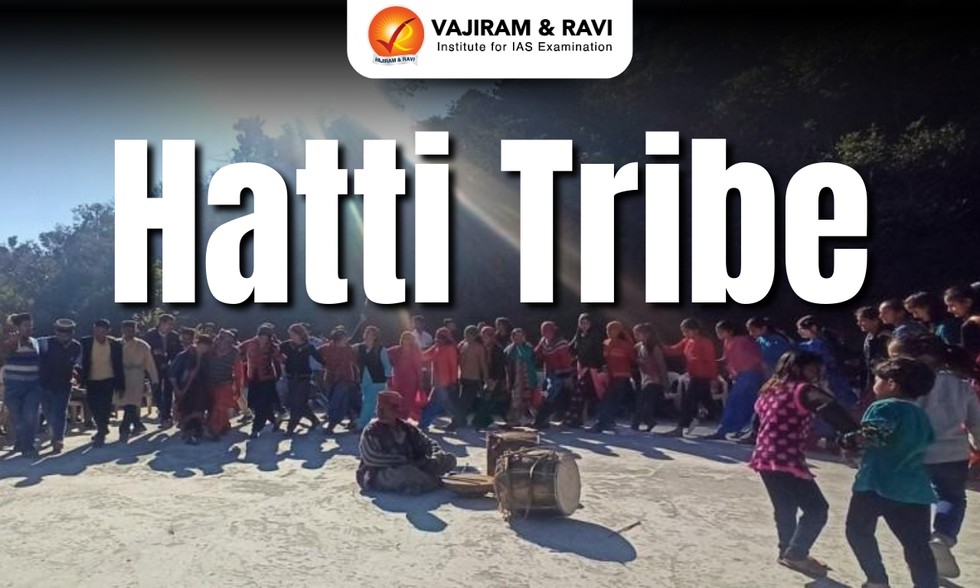
"Boda Tyohar", the biggest annual festival of the Hati tribe in Himachal Pradesh's Sirmour and celebrated by over three lakh community members, recently commenced with traditional fervour.
About Hatti Tribe:
The Hattis are a close-knit community who take their name from their age-old professional practice of selling their homegrown crops at small markets called ‘Haat’ in nearby cities.
Hatti men traditionally don distinctive white headgear on ceremonial occasions.
These tribal people reside in the Himachal-Uttarakhand border in the basin of the Giri and Tons rivers, both tributaries of the Yamuna.
There are two main Hatti clans: one in the Trans-Giri area of the Sirmaur district in Himachal Pradesh and the other in Jaunsar Bawar of Uttarakhand.
The two Hatti clans have similar traditions, and intermarriages are common.
Jodidara is a traditional form of polyandrous marriage practised among the Hatti tribe in Himachal Pradesh, where a woman marries two or more brothers.
Polyandry is legally recognised in Himachal Pradesh under revenue laws.
Harris is governed by a traditional council called ‘khumbli’ which decides community matters.
Economy: The Hatti population relies on agriculture for livelihood and bare subsistence since their climate is ideal for growing “Cash Crops.”
The Indian government has granted Scheduled Tribe (ST) status to the Hatti community in Himachal Pradesh.
The Jaunsar-Bawar region of Uttarakhand was granted tribal status in 1967.
Boda Tyohar, also called Magho ko Tyohar, is the biggest annual festival of the Hatti tribe.
Dear Student,
You have still not entered your mailing address. Please enter the address where all the study materials will be sent to you. (If applicable).