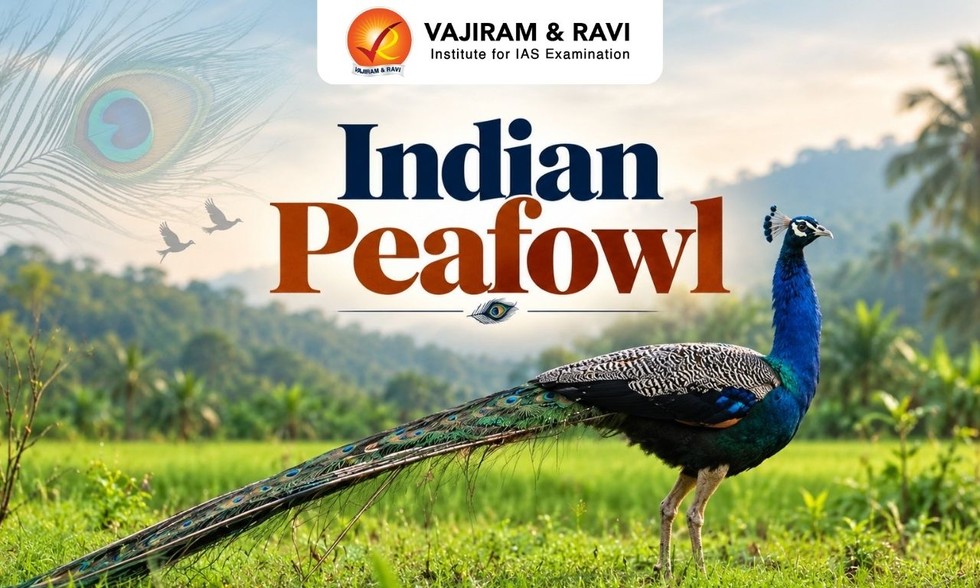
Orang National Park and Tiger Reserve recently recorded the Indian peafowl (Pavo cristatus) for the first time, adding a new species to the protected area’s biodiversity record and another chapter to Assam’s rich birdlife.
About Indian Peafowl:
Indian peafowl are a species in a group of birds called pheasants.
The males are called peacocks, while the females are called peahens. Together, they are peafowl.
Scientific Name: Pavo cristatus
Habitat and Distribution:
They are resident breeders across the Indian subcontinent and inhabit the drier lowland areas of Sri Lanka.
They are found in moist and dry deciduous forests near water and in montane forests and can also adapt to live in cultivated regions and around human habitations.
It is the national bird of India and has a significant cultural and historical presence.
Features:
Peafowl are among the largest of all birds that fly.
Males and females show strong physical differences.
Peacock is brightly colored, with a predominantly blue fan-like crest of spatula-tipped wire-like feathers, and is best known for the long train (tail) made up of elongated upper-tail covert feathers, which bear colorful eyespots.
These stiff feathers are raised into a fan and quivered in a display during courtship.
Despite the length and size of these covert feathers, peacocks are still capable of flight.
Peahens lack the train and have a greenish lower neck and duller brown plumage.
Diet: Omnivorous; feeds on seeds, grains, fruits, insects, reptiles, and other small animals.
Dear Student,
You have still not entered your mailing address. Please enter the address where all the study materials will be sent to you. (If applicable).