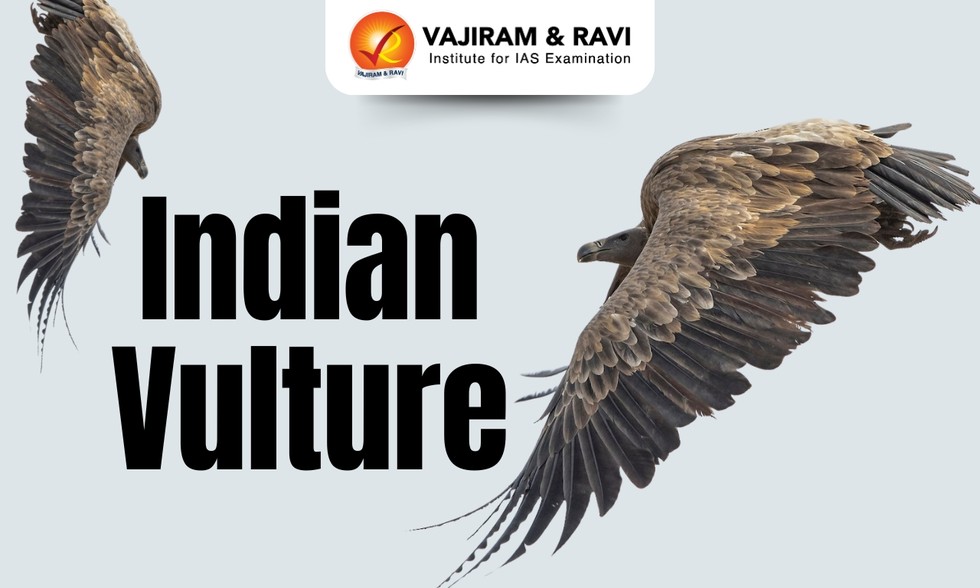
About Indian Vulture:
- The Indian vulture, also called the long-billed vulture, is a bird of prey native to Asia.
- Scientific Name: Gyps indicus
- It is part of a group called ‘’Old World vultures’’.
- They belong to the Accipitridae family, which includes eagles and hawks.
- Habitat and Distribution:
- These are native to India, Pakistan, and Nepal.
- They are usually found in savannas and other open habitats around villages, cities, and near cultivated areas.
- It has suffered a 97-99% population decrease due to poisoning caused by the veterinary drug diclofenac.
- It was given to working animals, as it reduced joint pain and so kept them working for longer.
- Vultures got poisoned when they ate the meat of dead cattle that had been treated with diclofenac. This caused kidney failure in the vultures.
- Features:
- It is a bulky medium-sized Females of this species are smaller than males.
- They have a small, mostly bald head with few feathers.
- It has a long, featherless neck, dark eyes, and a long, yellowish beak.
- Its body and covert feathers are light brown.
- Its wings are broad, and its tail feathers are short.
- Its large wingspan allows it to fly long distances while using minimal energy.
- Conservation Status:
- IUCN Red List: Critically Endangered.
Key Facts about Melghat Tiger Reserve:
- It is located in Maharashtra’s Amravati district.
- Perched on the southern offshoot of the Satpura Hill Range, also known as the Gavilgarh Hills, the very name Melghat translates to “meeting of the ghats.”
- It was the first tiger reserve in Maharashtra.
- Rivers: The Tapti River flows gracefully along the reserve’s northeastern boundary, while five tributaries—Khandu, Khapra, Sipna, Gadga, and Dolar—crisscross the sanctuary.
- Tribes: The Korkus are the largest tribal community in Melghat.
- Flore:
- It is dominated by tropical dry deciduous
- Towering teak trees (Tectona grandis) dominate, interspersed with other valuable species such as Ain (Terminalia tomentosa), Haldu (Adina cordifolia), and Bamboo.
- Fauna:
- Sloth Bear, Indian Gaur, Sambar deer, Leopard, Nilgais, dhole, hyena, jungle cat, langur, etc.
- It is considered a stronghold of the critically endangered forest owlet.