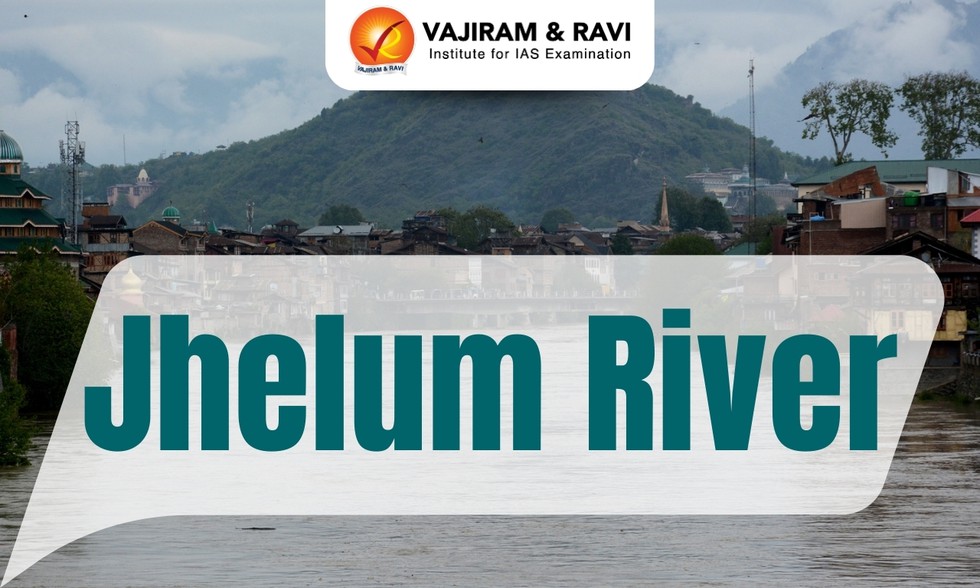
The Kashmir Valley is witnessing one of its most unusual early springs in decades, with the river Jhelum, its lifeline, dropping below the zero-gauge level while temperatures surge to record highs.
About Jhelum River:
It is an important river that flows through northwestern India and eastern Pakistan.
It is a tributary of the Indus River.
The river is also known as Vitasta in Sanskrit, Hydaspes in Greek, and Bidasp in Persian.
It is the lifeline of Kashmir, the region where it flows for most of its course.
It is the largest and most western of the five rivers of Punjab and passes through the Jhelum District in the North of Punjab province, Pakistan.
Course:
It originates at the Verinag Spring at Anantnag, at the foot of the Pir Panjal range in the Kashmir Valley.
The river meanders northwestward from the northern slope of the Pir Panjal Range through the Vale of Kashmir to Wular Lake at Srinagar, which controls its flow.
The river makes a deep, narrow gorge on its way to Pakistan.
It joins the Chenab River near Trimmu, Pakistan.
The hydrology of the Jhelum River is largely controlled by snowmelt from the Karakoram and Himalaya ranges in the spring and the southwest monsoon on the Indian subcontinent that brings heavy rains from June to September.
Major Tributaries:
The largest tributary of the Jhelum is the Kishenganga (Neelum) River, which joins near Muzaffarabad and enters the Punjab province, Pakistan.
The Kunhar River is the second largest tributary of the river, which connects Pakistan-occupied Kashmir (PoK) and Pakistan on the Kohala Bridge of the Kanghan valley.
Other tributaries include the Sandran River, Bringi River, Arapath River, Watlara River, Lidder River, and Veshaw River.
Dear Student,
You have still not entered your mailing address. Please enter the address where all the study materials will be sent to you. (If applicable).