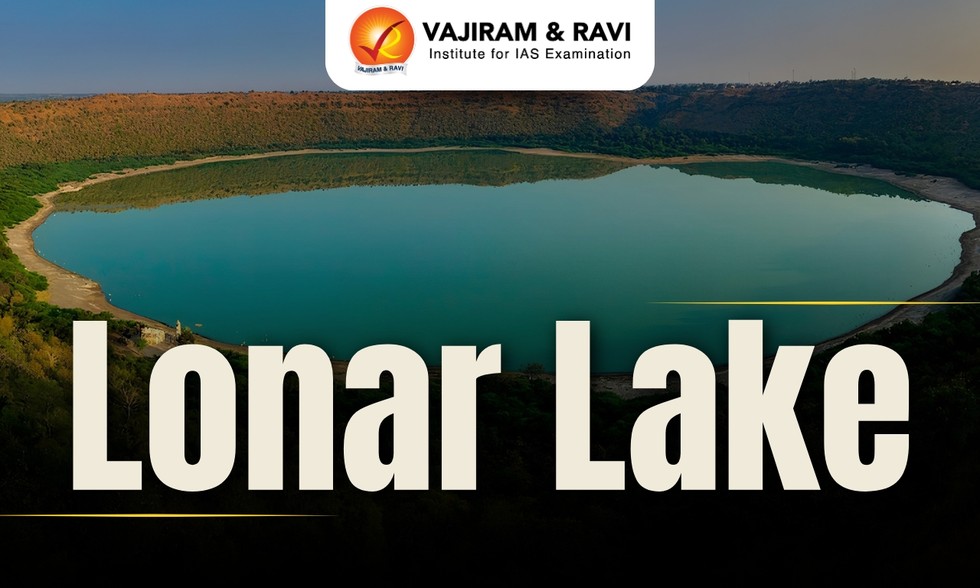
At a time when water levels in reservoirs and lakes are receding and groundwater is depleting across Maharashtra, the Lonar crater-lake is throwing up a mystery — its water level is rising.
About Lonar Lake:
Lonar Lake (also known as Lonar Crater) is situated in the Buldhana district of Maharashtra.
It is less than 1.6 km in diameter, and sits in a nearly circular bowl.
It sits inside the Deccan Plateau—a massive plain of volcanic basalt rock leftover from eruptions some 65 million years ago.
Its location in this basalt field suggested to some geologists that it was a volcanic crater.
Today, however, Lonar Crater is understood to result from a meteorite impact that occurred around 50,000 years ago.
It is the only known impact crater lake in basaltic rock in the world.
It is the only known saline crater lake in the world. Its water is seven times saltier than seawater due to the presence of basalt rock.
The basin is surrounded by steep slopes and centuries-old temples.
It has several springs around the lake that supply water to the lake.
It has several vents around the lake that release gases such as methane, carbon dioxide, hydrogen sulphide, etc.
One of the most striking aspects is its color, which changes from green to pink depending on the season and the water conditions.
This is caused by thepresence of microorganisms that thrive in the saline and alkaline environment of the lake.
It finds its inclusion in the Puranas and other ancient scriptures, including the Aaina-i-Akbari.
Dear Student,
You have still not entered your mailing address. Please enter the address where all the study materials will be sent to you. (If applicable).