
Key Facts about Musi River
Telangana CM recently chaired a high-level review meeting on Monday, directing officials to expedite the Musi River Rejuvenation project.
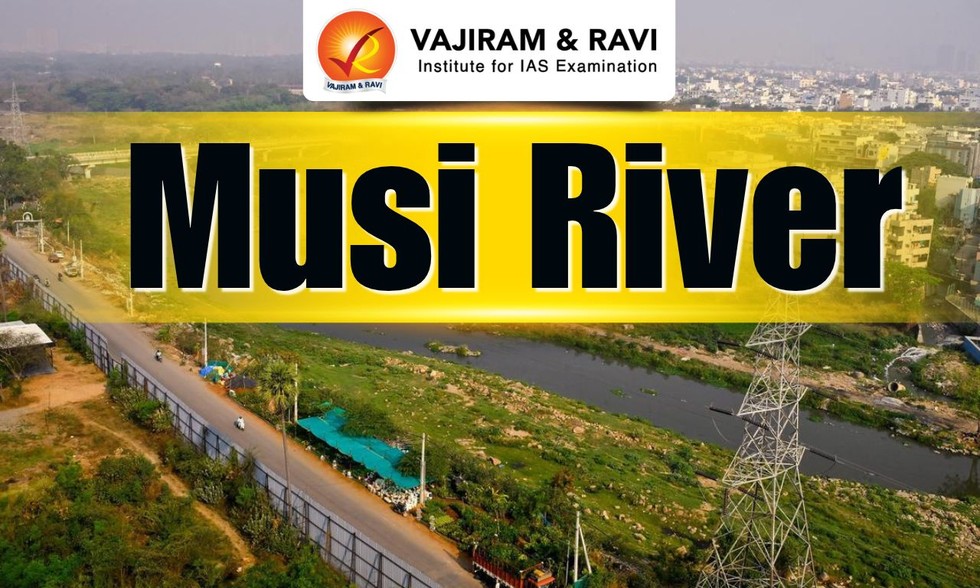
About Musi River:
- The Musi River, also known as the Muchukunda or Musunuru River, is a significant tributary of the Krishna River in the Deccan Plateau, flowing through Telangana.
- The river gained prominence in the late 16th century when Muhammad Quli Qutb Shah, the founder of Hyderabad, established the city along its banks.
- Course:
- It originates from Anantagiri Hills in Vikarabad district on the outskirts of Hyderabad.
- The river is formed by the merging of two small rivulets: Esi and Musa
- After originating, the Musi River flows in an eastward direction, cutting through the heart of Hyderabad city, where it historically divided the Old City from the New City.
- The river then continues its journey through the southern Telangana plains.
- It ultimately joins the Krishna River near Wazirabad in Nalgonda district.
- Total Length: 240 kilometers.
- Dams Across the Musi River:
- Osman Sagar:
- Built in 1920 after the 1908 Hyderabad floods.
- Acts as a major source of drinking water for Hyderabad.
- Also supports irrigation and flood control.
- Himayat Sagar:
- Constructed in 1927.
- Forms another essential reservoir contributing to Hyderabad’s water supply.
- Mir Alam Tank:
- Built in 1806, predating both Osman and Himayat Sagar.
- Historically supplied water to the city and remains a landmark.
- Osman Sagar:
- Hussain Sagar Lake was built on a tributary of the River Musi. It was a lake of 24 kilometres, built to meet the water and irrigation needs of the city.
- Several historic bridges and mosques line its banks, reflecting Qutb Shahi and Nizam-era architecture.
- In 2025, the Musi River Historic Buildings in Hyderabad were listed in the World Monuments Watch, a prestigious global advocacy program by the World Monuments Fund (WMF).
- The Musi River has 24 diversion weirs for irrigation, locally known as kathwas.
- Now, due to random urbanization and lack of planning the river has become a holder of all the unprocessed domestic and industrial waste drained out of Hyderabad.
Source: Telangana CM pushes to fast-track Musi River rejuvenation