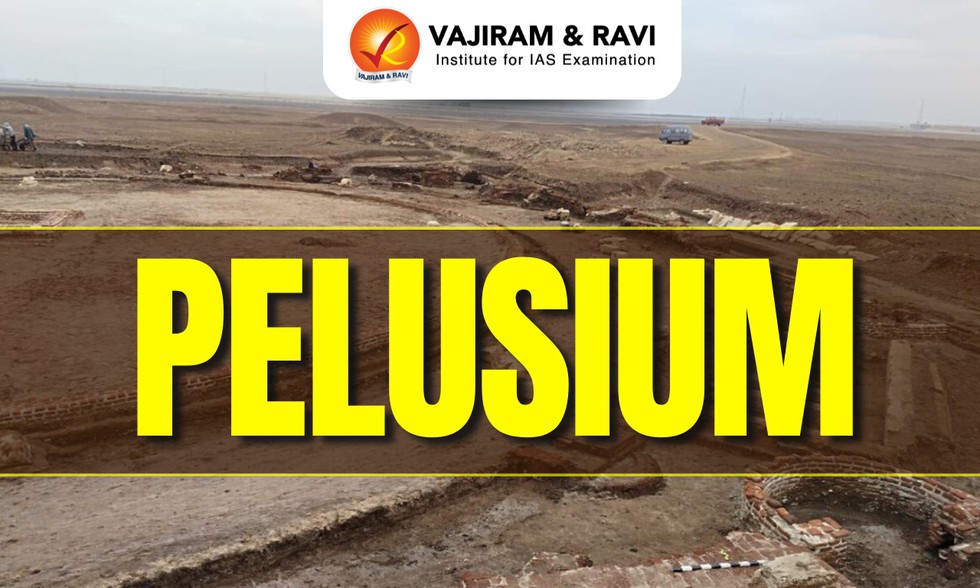
The excavation at the Tell el-Farama site in northern Sinai by an Egyptian archaeological team has concluded and resulted in the discovery of a rarely seen round temple within the ruins of the ancient city of Pelusium, which also has a new identity than previously believed.
About Pelusium:
Pelusium, located at the easternmost mouth of the Nile in Egypt, is an ancient city known for its historical significance and cultural heritage.
It lies southeast of Port Said, in the Sinai Peninsula.
Originally called Sainu and Per-Amun, after its principal deity, Pelusium became a vital fortress and customs post on the border with Judaea during Pharaonic times.
The city was particularly famous for its flax production.
It witnessed several notable military events, including Cambyses' conquest in 525 BC (Battle of Pelusium, in which Persian king Cambyses II defeated Pharaoh Psamtik III’s Egyptian army) ,and later sieges involving Athenian assistance and attacks from various rulers, such as Artaxerxes III and the Seleucid king Antiochus IV.
After Alexander the Great's death, Pelusium served as an important customs station under the Ptolemies (a Greek (Macedonian) dynasty that ruled Egypt).
It was also the site of significant conflict during the Roman period, particularly during the rise of Octavian (Augustus) following the defeat of Antony and Cleopatra.
Under the later Roman Empire, Pelusium was incorporated into the province of Augustamnica, affirming its enduring importance in the region’s history.
Dear Student,
You have still not entered your mailing address. Please enter the address where all the study materials will be sent to you. (If applicable).