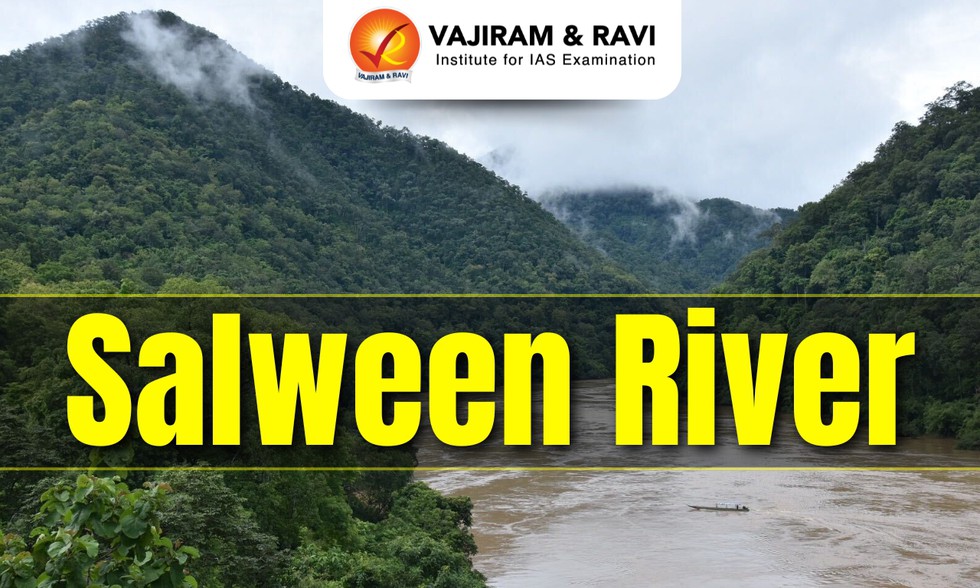
Recent discoveries have indicated severe arsenic pollution along the Salween River, with unregulated mines in Myanmar, especially Shan State, being the prime suspects.
About Salween River:
The Salween River, also known as the Nu River in China and Thanlwin River in Myanmar, is a transboundary river in Asia, shared by China, Thailand, and Myanmar.
It is the longest undammed/free-flowing river in mainland Southeast Asia.
Course:
The Salween River originates in the Tibetan range of the eastern Himalayas.
The river passes through western Yunnan, China, Myanmar, and then forms the border between Myanmar and Thailand before it turns west and drains into the Gulf of Martaban in the Andaman Sea.
The upstream portion of the Salween flows in parallel with two of Asia’s mightiest rivers, the Mekong and the Yangtze.
The location where three gorges carved by these rivers come together – the Three Parallel Rivers of Yunnan – was designated as a World Heritage Site by the UN in 2003.
Since Salween flows primarily through rugged terrain with dangerous rapids along its course, only small parts of the river are navigable by large water vessels.
Its major economic use is in floating teak logs from the forests of southeastern Myanmar to the sea.
Some of the major ethnic groups in the region include the Shan, Karen (or Kayin), Karenni (or Kayah), Wa, Lisu, Lahu, Kokang, Akha, and Hmong.
Dear Student,
You have still not entered your mailing address. Please enter the address where all the study materials will be sent to you. (If applicable).