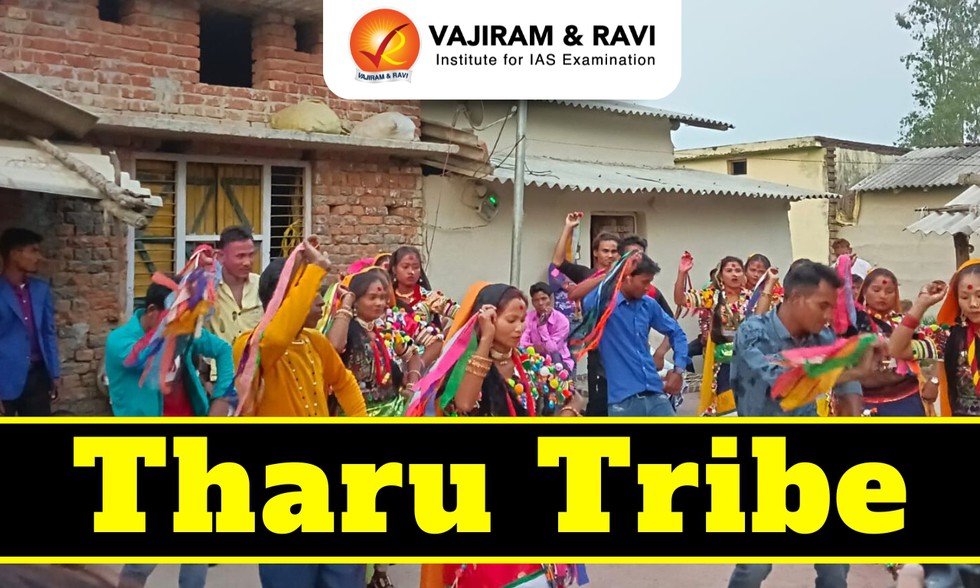
The Lucknow bench of the Allahabad High Court recently set aside a district-level committee’s decision to reject the community forest rights claims of the Tharu tribe in Lakhimpur Kheri.
About Tharu Tribe:
The Tharu tribe is one of the indigenous groups living in the Terai plain on the Indo-Nepal border.
The Tharu are the largest and oldest ethnic group of the Terai region.
They live in both India and Nepal.
In the Indian Terai, they live mostly in Uttarakhand, Uttar Pradesh, and Bihar.
In 1967, this tribe was documented as a Scheduled Tribe by the Government of India.
Language: They have their own language called Tharu or Tharuhati, a language of the Indo-Aryan subgroup of the Indo-Iranian group of the Indo-European family.
Economy: Most Tharu practice agriculture, raise cattle, hunt, fish, and collect forest products.
Most of their food involves rice, lentils, and vegetables.
Tharu traditional homes, known as “Badaghar,” are made with local materials such as mud, wood, and thatch.
Society:
Despite their patrilineal social system,women have property rights greatly exceeding those recognized in Hindu society.
Tharu marriages are patrilocal within the tribe.
A common feature of the Tharu community is the joint family system of living in long houses.
Tharus live in compact villages, usually in the middle of a forest clearing.
The Panchayat system (Local Social Council) is very strong in this tribe; the head of the panchayat is called ‘’Pradhan’’ in the local Tharu language.
Religion: The Tharu people practice a unique blend of animism, Hinduism, and nature worship.
Dear Student,
You have still not entered your mailing address. Please enter the address where all the study materials will be sent to you. (If applicable).