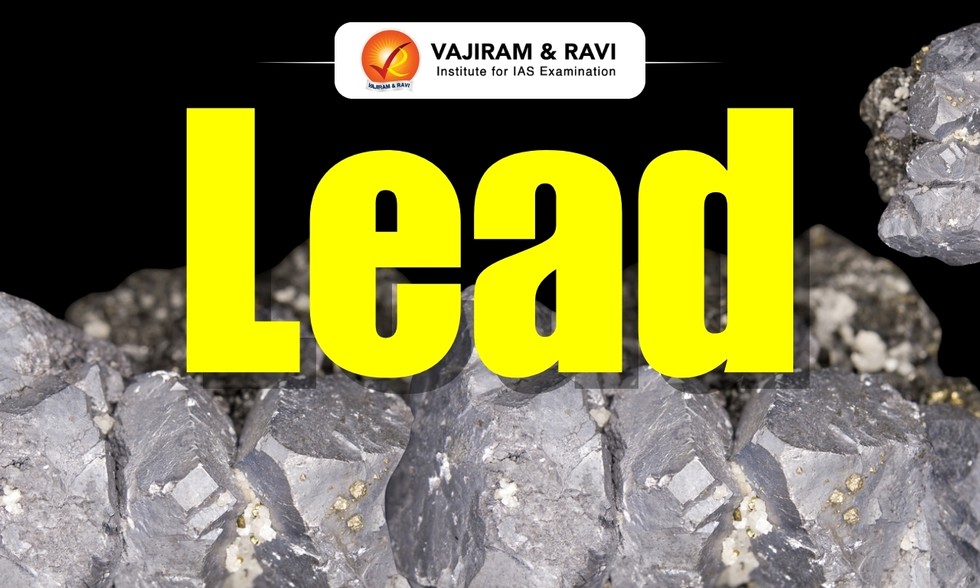
Researchers at the ICMR-National Institute of Nutrition (ICMR-NIN), Hyderabad, have found that exposure to lead can significantly disrupt the natural waste-clearing and recycling system of nerve cells.
About Lead:
It is a naturally occurring element found in small amounts in the earth’s crust.
Properties:
It is a soft, silvery white or grayish metal in Group 14 (IVa) of the periodic table.
Lead has a bright lustre and is a dense, ductile, very soft, highly malleable, bluish-white metal that has poor electrical conductivity.
It is also highly resistant to corrosion and because of this property is used to contain corrosive liquids (e.g. sulphuric acid).
Occurrence: It is usually found in ore with zinc, silver and copper and is extracted together with these metals.
The main lead mineral is galena (PbS). Other common varieties include cerussite (PbCO3) and angelsite (PbSO4).
Uses of Lead:
It used for lead-acid batteries for vehicles, backup emergency systems, the telecoms sector and fork lift trucks.
It is also used in rolled and extruded products, compounds in the glass and plastics industries, shot and ammunition and for radiation shielding.
Impacts of Lead on Human Health:
It is highly toxic to humans and the environment.
Exposure to lead can affect multiple body systems and is particularly harmful to young children and women of child-bearing age.
Dear Student,
You have still not entered your mailing address. Please enter the address where all the study materials will be sent to you. (If applicable).