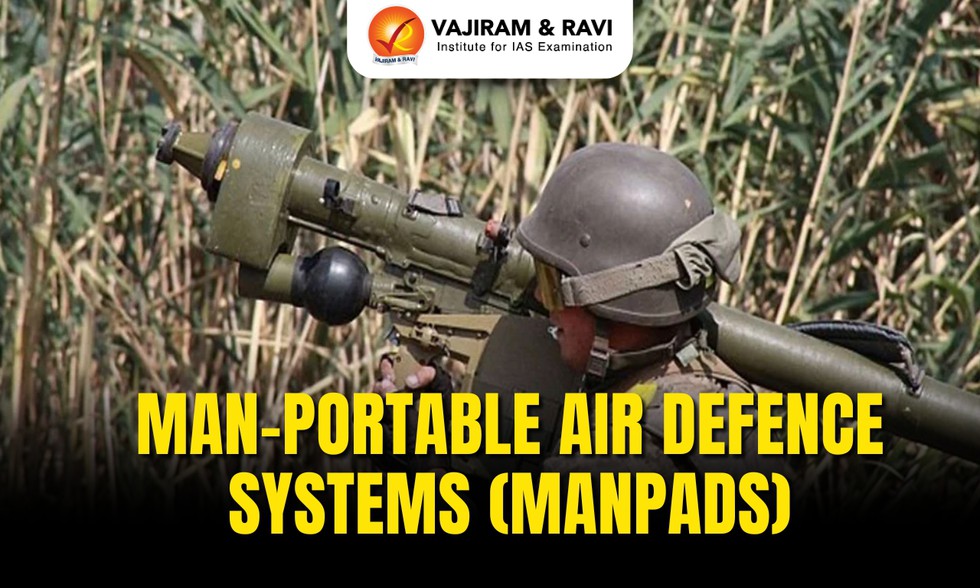
About Man-Portable Air Defence Systems (MANPADS):
- MANPADS are surface-to-air missiles that can be fired by an individual or a small team of people against aircraft.
- These weapon systems often are described as shoulder-fired anti-aircraft missiles.
- The United States and the Soviet Union first deployed MANPADS—the Redeye and Strela systems, respectively—in the 1960s to provide their infantries with portable anti-aircraft weapons.
- The militaries of many countries across the world operate MANPADS, although only few countries, including India, produce them.
- The most famous MANPADS are the US-made ‘Stinger’ and the Soviet 9K32 Strela-2, or simply ‘SA-7' with the China-made ‘FN-16’ being the latest entrant.
- Three general types of MANPADS exist: command line of sight, laser guided, and infrared seekers.
- Command line-of-sight MANPADS are guided to their targets through the use of a remote control.
- Laser-guided or laser beam rider MANPADS follow a laser projected onto the target.
- The most common MANPADS, frequently called heat seeking missiles, however, are infrared seekers that acquire their target by detecting the heat of an aircraft’s engine.
- Most MANPADS consist of:
- a missile packaged in a tube;
- a launching mechanism (commonly known as a “gripstock”); and
- a battery.