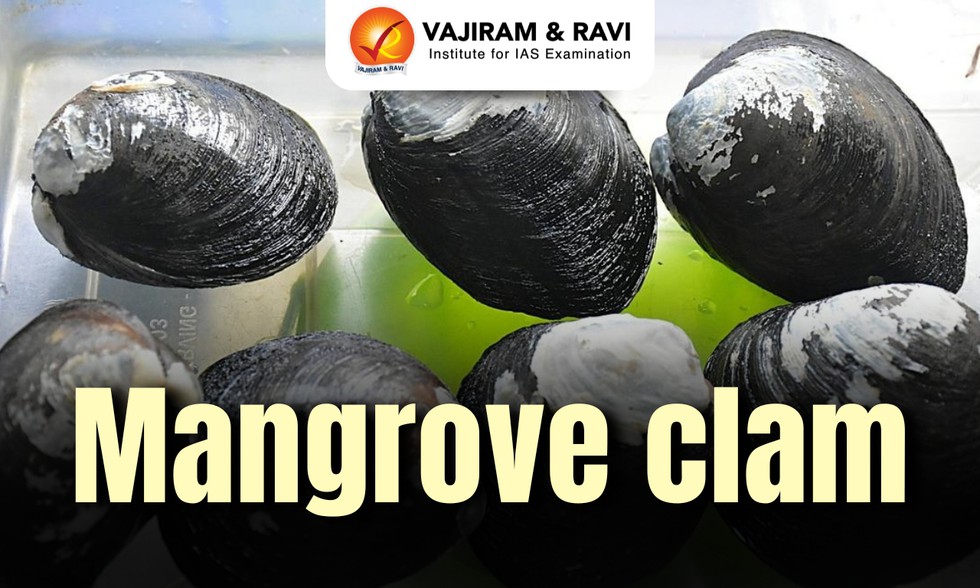
Recently, the ICAR–Central Marine Fisheries Research Institute (CMFRI) has successfully achieved captive breeding of the mangrove clam (Geloina erosa).
About Mangrove clam:
Mangrove clams, commonly known as mud clams, locally called 'Kandal Kakka' in northern Kerala.
It belongs to the genus Polymesoda or Geloina.
Habitat: They are found in muddy, brackish and even nearly freshwater regions within mangrove swamps.
Distribution: These are widely distributed in the Indo-Pacific region.
Characteristics of Mangrove clam:
It is a burrowing bivalve inhabiting organic-rich muddy substrates in intertidal mangrove ecosystems.
This species display remarkable tolerance, enabling them to thrive across a broad spectrum of salinity levels.
It is a filter-feeding species, primarily active during low-tide immersion stages characterized by frequent inundation.
It plays a crucial ecological role by recycling nutrients, stabilising sediments and strengthening mangrove ecosystems.
Threats: In India, particularly along the east coast and in island regions, wild stocks have been steadily declining due to indiscriminate harvesting, habitat degradation, pollution and coastal development.
Dear Student,
You have still not entered your mailing address. Please enter the address where all the study materials will be sent to you. (If applicable).