Recently, the Supreme Court refused to interfere with the Bombay High Court order allowing the removal of 45,675 mangrove trees for the proposed Versova-Bhayandar coastal road.
About Mangroves:
Mangroves are salt-tolerant trees and shrubs that grow in coastal intertidal zones, primarily in tropical and subtropical regions.
It thrives in saline or brackish waters, withstanding harsh environmental conditions such as tidal fluctuations, high salinity and lowoxygen levels in the soil.
Mangroves Characteristics:
Salt Tolerance: They possess specialised root structures, such as salt-filtering roots and salt-excreting leaves, to manage high salinity levels.
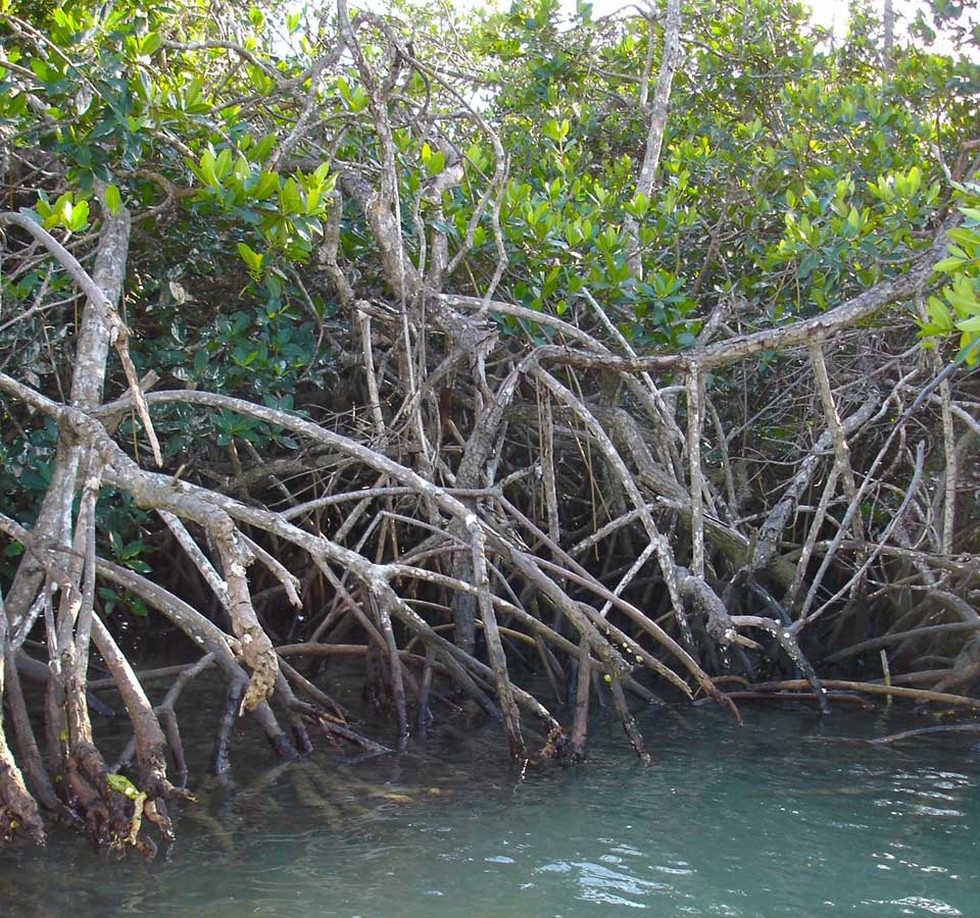
Aerial Roots (Pneumatophores): These roots help in respiration by obtaining oxygen from the air in waterlogged soils.
Prop Roots: Provide stability against tidal waves and storm surges.
Vivipary (Seed Germination): Seeds germinate while still attached to the parenttree to overcome the challenge of germination in saline water.
Efficient Carbon Sequestration: Mangroves are among the most carbon-rich ecosystems, playing a vital role in mitigating climate change.
Mangrove forests act as a crucial buffer between land and sea, providing habitat for various marine and terrestrial species.
In India this ecosystem is found in Sundarbans (West Bengal), Mahanadi, Godavari, and Krishna Deltas (Odisha & Andhra Pradesh), Pichavaram Mangroves (Tamil Nadu), Bhitarkanika Mangroves (Odisha), Gulf of Kutch (Gujarat), Andaman & Nicobar Islands and Lakshadweep regions.
Dear Student,
You have still not entered your mailing address. Please enter the address where all the study materials will be sent to you. (If applicable).