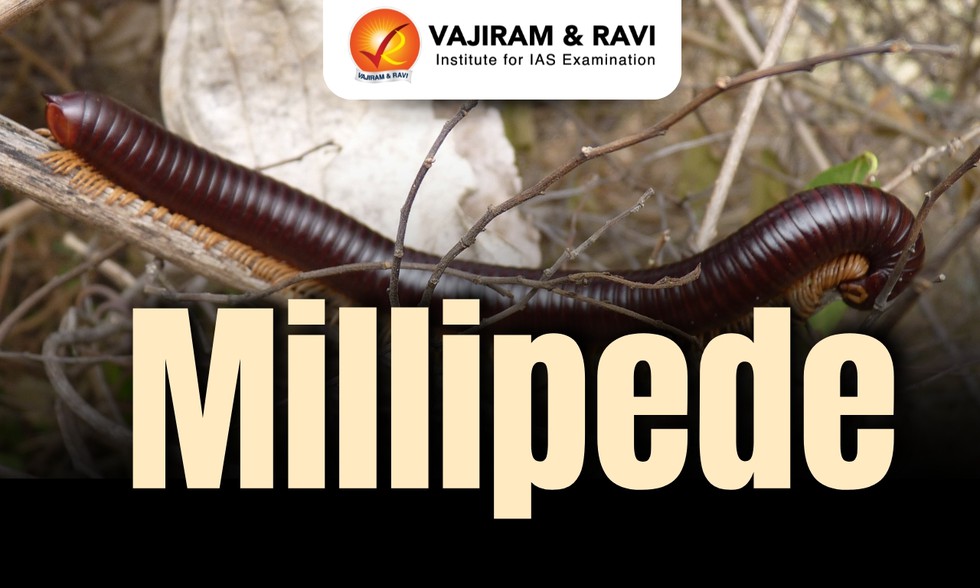
A recent study has revealed the self-cleaning mechanism similar to the famous ‘lotus effect’ (the natural self-cleaning property of lotus leaves) to stay clean by green pill millipede, a species endemic to the Western Ghats.
About Millipede:
Millipedes are cylindrical or slightly flattened invertebrates.
They constitute the class Diplopoda within the subphylum Myriapoda.
The name ‘millipede’ derives from the Latin words‘mille’, meaning thousand, and ‘pes’, meaning foot.
Appearance:
They are slow-moving arthropods having long, segmented bodies, with most segments bearing two pairs of legs attached to the underside of the body.
Their exoskeleton is typically brown to black in color, and thus, they can easily remain camouflaged in the soil.
Habitat: Their highest diversity is found in the tropical region, where they inhabit moist microhabitats on the forest floor, including leaf litter, dead wood, and soil.
Distribution: These arthropods are found on all continents except Antarctica.
Features:
Defence Mechanism: They lack speed or the ability to bite or sting, their primary defensive mechanism is curling into a coil, exposing their protective exoskeleton to the predator.
Diet: Most species are typically detritivores, feeding on rotting leaves, wood, and other decomposing plant debris.
Ecological Role: They act as decomposers, conserving soil erosion and nutrient cycling, and are among the greatest vital foliage litter creatures.
Dear Student,
You have still not entered your mailing address. Please enter the address where all the study materials will be sent to you. (If applicable).