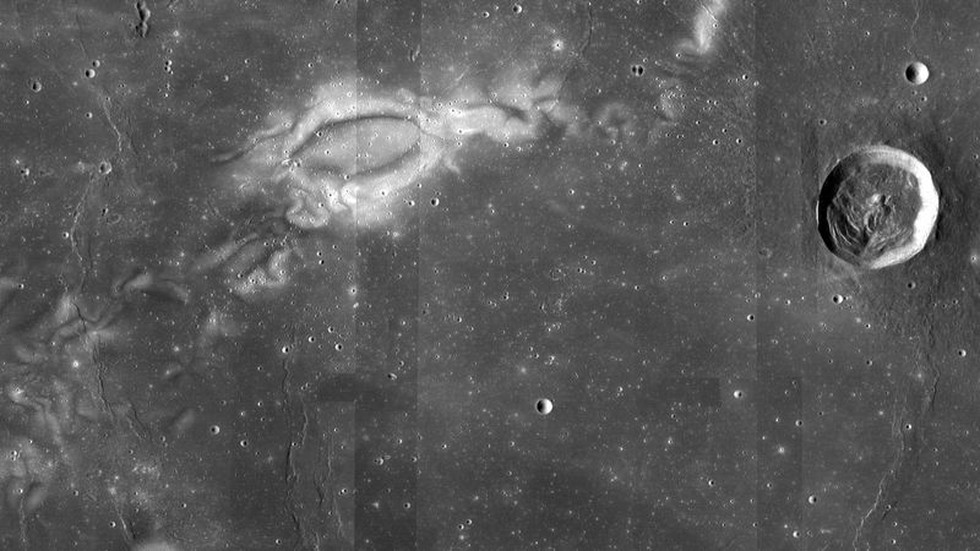
Research using data from NASA's Acceleration, Reconnection,Turbulence and Electrodynamics of the Moon's Interaction with the Sun (ARTEMIS) mission have discovered that the Moons 'sunburns' -- distinctivepatterns of swirls -- are a result of interactions between the Sun's damaging radiation with pockets of lunar magnetic field.
About:
The Sun releases a continuous outflow of particles and radiation called the solar wind. The solar wind washes over the planets, moons and other bodies in our solar system, filling a bubble of space -- called the heliosphere -- that extends far past the orbit of Pluto.
On Earth, we are largely protected from the damaging effects of the solar wind. Since the solar wind is magnetised, Earth's natural magnetic field deflects the solar wind particles around our planet so that only a small fraction of them reach our planet's atmosphere.
Unlike Earth, the Moon has no global magnetic field. However, magnetised rocks near the lunar surface do create small, localised spots of magnetic field that extend anywhere from hundreds of yards to hundreds of miles.
These small bubbles of magnetic "sunscreen" can also deflect solar wind particles -- but on a much smaller scale than Earth's magnetic field. This has a fundamental effect on the Moon's appearance.
Under these miniature magnetic umbrellas, the material that makes up the Moon's surface, called regolith, is shielded from the Sun's particles.
As those particles flow toward the Moon, they are deflected to the areas just around the magnetic bubbles, where chemical reactions with the regolith darken the surface.
This creates the distinctive swirls of darker and lighter material that are so prominent they can be seen from Earth.
Dear Student,
You have still not entered your mailing address. Please enter the address where all the study materials will be sent to you. (If applicable).