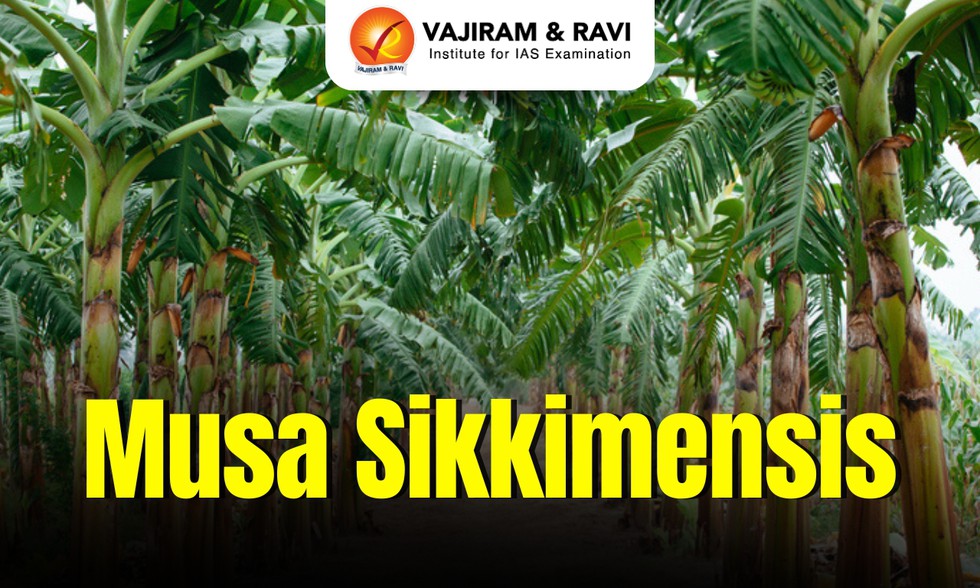
Researchers at Nagaland University highlighted genetic richness of wild banana Musa sikkimensis for climate-resilient farming.
About Musa sikkimensis:
It is a wild banana species.
It is native to the Eastern Himalayas and Northeast India.
Other Names: It is commonly known as the ‘Darjeeling banana’ or ‘Sikkim banana’,
Features of Musa sikkimensis:
It is a tall, evergreen perennial plant that belongs to the banana family.
It has large, paddle-shaped leaves that can grow up to 10 feet (3 meters) long and 2 feet (60 cm) wide.
The plant produces beautiful, pendulous flowers that are a deep maroon color and can grow up to 2 feet (60 cm) long.
It is not widely cultivated for edible fruit. It plays a crucial role in strengthening crop resilience and ensuring sustainable production.
Its germplasm exhibits strong adaptive potential across diverse environmental conditions.
It is a wild-seeded species that serves as a crucial genetic reservoir.
Required Climatic Conditions for Musa sikkimensis:
It prefers high humidity levels, around 50-60%.
It prefers warm temperatures between 20-30°C.
It can tolerate cooler temperatures, but not below 10°C.
Significance: It possesses traits linked to disease resistance, environmental stresstolerance and climate adaptability, making it an invaluable resource for future banana breeding and crop improvement programmes.
Dear Student,
You have still not entered your mailing address. Please enter the address where all the study materials will be sent to you. (If applicable).