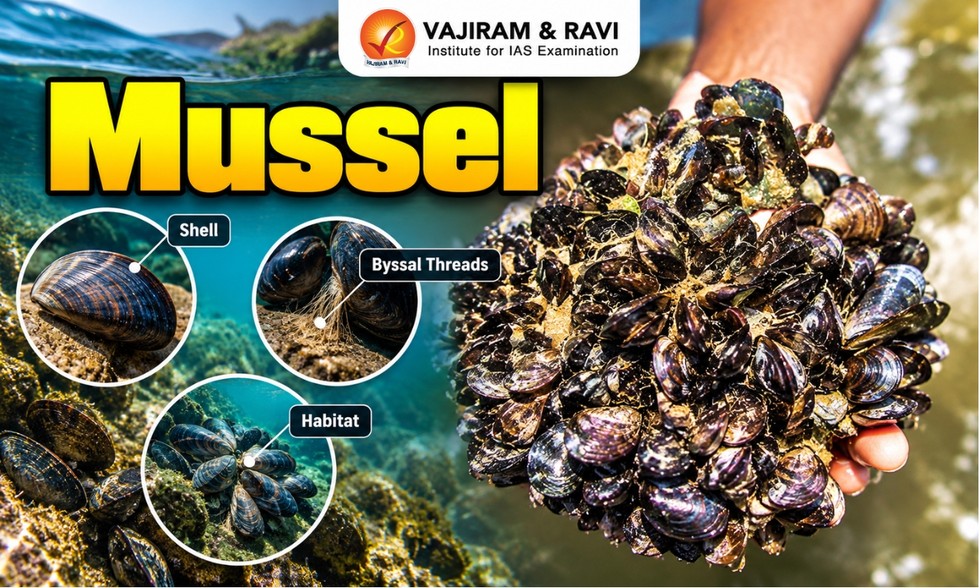
Recently, the ICAR-Central Marine Fisheries Research Institute (ICAR-CMFRI) unit at Vizhinjam has launched its first full-fledged open-sea mussel longline farming unit.
About Mussel:
It is a bivalve of mollusks belonging to the marine family Mytilidae and to the freshwater family Unionidae.
Distribution: They are most common in cool seas. Freshwater mussels known as naiads inhabit streams, lakes, and ponds over most of the world.
Features of Mussel
Appearance: Marine mussels are usually wedge-shaped or pear-shaped
They may be smooth or ribbed and often have a hairy covering.
The shells of many species are dark blue or dark greenish brown on the outside; on the inside they are often pearly.
They attach themselves to solid objects or to one another by proteinaceous threads called byssus threads.
They often occur in dense clusters.
Benefits of Mussel:
Food Source: They are edible and considered nutritious, rich in protein, omega-3 fatty acids, and various vitamins and minerals.
Pearl Production: Freshwater mussels are used for pearl cultivation.
Ecological Role: These species are filter-feeding organisms that absorb a range of contaminants into their tissue, including invisible microplastics.
They have been used globally for decades as a barometer of marine pollution.
Dear Student,
You have still not entered your mailing address. Please enter the address where all the study materials will be sent to you. (If applicable).