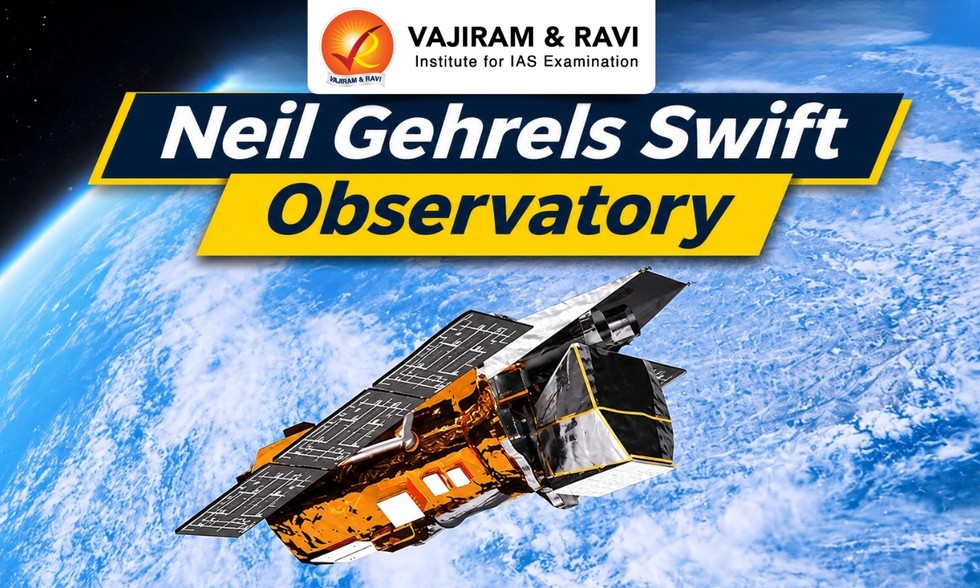
About Neil Gehrels Swift Observatory:
- It was launched by National Aeronautics and Space Administration (NASA) in 2004.
- It was aimed to explore the universe’s most powerful explosions, called gamma-ray bursts.
- It is part of NASA's medium explorer (MIDEX) program and was launched into a low-Earth orbit on a Delta 7320 rocket.
- Objectives:
- Determine the origin of gamma-ray bursts and how the burst evolves and interacts with the surroundings.
- Classify gamma-ray bursts and search for new types.
- Use gamma-ray bursts to study the early universe.
- Perform the first sensitive hard X-ray survey of the sky.
- It was comprised of three instruments namely
- Burst Alert Telescope (BAT): It had large field-of-view and high sensitivity, the BAT detected about 100 GRBs per year, and computes burst positions onboard the satellite with arc-minute positional accuracy.
- X-ray Telescope (XRT): It was able to obtain spectra of GRB afterglows during pointed follow-up observations. The images are used for higher accuracy position localizations, while light curves are used to study flaring and the long-term decay of the X-ray aferglow.
- UV/Optical Telescope (UVOT): The UVOT took images and can obtain spectra (via a grism filter) of GRB afterglows during pointed follow-up observations.
- Achievements: Since its launch, Swift had also studied hundreds of supernova explosions, star-shredding black holes, stellar X-ray flares, asteroids and comets, contributing to some 7,000 published scientific papers.