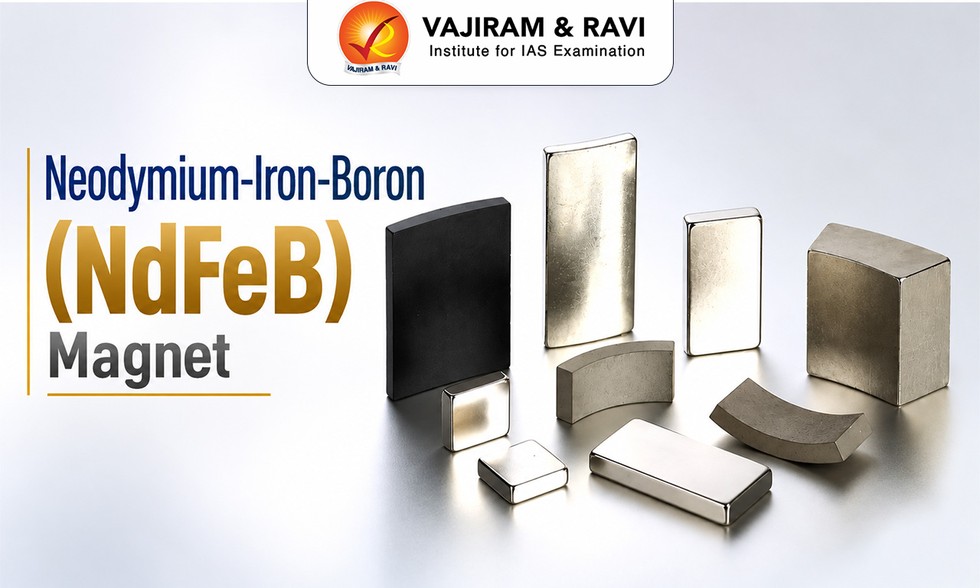
About Neodymium-Iron-Boron (NdFeB) Magnets:
- NdFeB magnets are a type of rare-earth permanent magnet composed of an alloy of neodymium (Nd), iron (Fe), and boron (B).
- First developed in the early 1980s, they are the strongest commercially available permanent magnets in the world, offering an extraordinary combination of high magnetic energy density, coercivity, and remanence in a compact size.
- The chemical formula for the primary magnetic phase in an NdFeB magnet is Nd₂Fe₁₄B — a tetragonal crystalline structure that gives the material its exceptional magnetic properties.
- Typically, the composition includes 29-32.5% neodymium, 64-69% iron, and 1-1.2% boron.
- Their magnetic performance can deteriorate at high temperatures, although specialized grades are designed for higher-temperature applications.
- The addition of heavy rare-earth elements like dysprosium (Dy) or terbium (Tb) is common in high-temperature grades to maintain performance above 150°C.
- All the NdFeB magnets are prone to corrosion. They will require a form of protective coating. The standard coating is a triple-layer plating of nickel copper nickel (Ni-Cu-Ni).
- Applications:
- NdFeB magnets find widespread use in various industries, including electronics, automotive, medical devices, renewable energy, and more.
- In everyday products like headphones, electric motors, sensors, speakers, and generators, NdFeB magnets deliver enhanced performance, underlining their adaptability in modern technology.