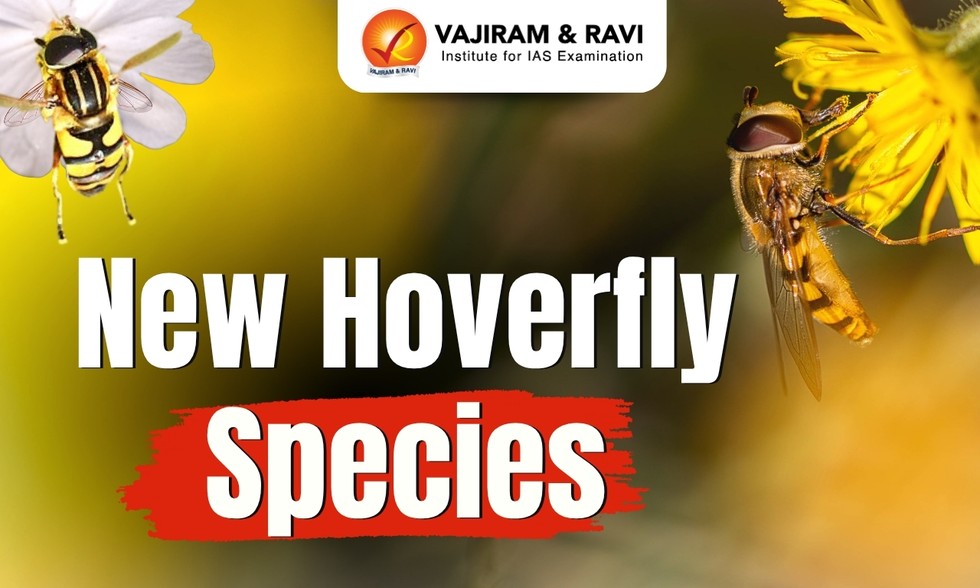
About Eristalinus sapphirinus and Eristalinus brunettii:
- These are two new species of hoverflies.
- They were discovered from the Gangetic Plains of West Bengal.
- Eristalinus sapphirinus is named for its striking, sapphire-blue metallic coloration.
- Eristalinus brunettii is named in honour of entomologist Enrico Adelelmo Brunetti, acknowledging his immense historical contributions to the study of Indian Diptera (flies).
- The discovery expands the known diversity of the Eristalinus genus in India, with the last major contribution to the group's taxonomy dating back to 1923.
- Members of the Eristalinus genus support ecosystems in two distinct life stages.
- As adults, they act as critical pollinators for wild and cultivated plants.
- As larvae (commonly known as "rat-tailed maggots"), they develop in aquatic habitats where they decompose organic matter and recycle essential nutrients.
What are hoverflies?
- Hoverflies, often referred to as flower flies or drone flies, are beneficial insects that appear in large numbers during the spring and summer.
- They belong to the order Diptera and the family Syrphidae.
- They are often mistaken for bees or wasps and can cause undue fear over possible stings.
- However, they do not possess stingers.
- Hoverflies can be readily distinguished from wasps and bees by their single pair of wings. In comparison, bees and wasps have two pairs of wings.
- Hover flies also have a typical fly head with short antennae and bulbous eyes.
- Adult hover flies are 4-10 mm long and have dark flattened bodies with black and yellow markings.
- During flight, many hover flies move in a characteristic way. As their name suggests, they hover over objects but will also dart to and fro.
- Hoverflies are among the most important pollinators globally, providing pollination services to many crops and natural vegetation.