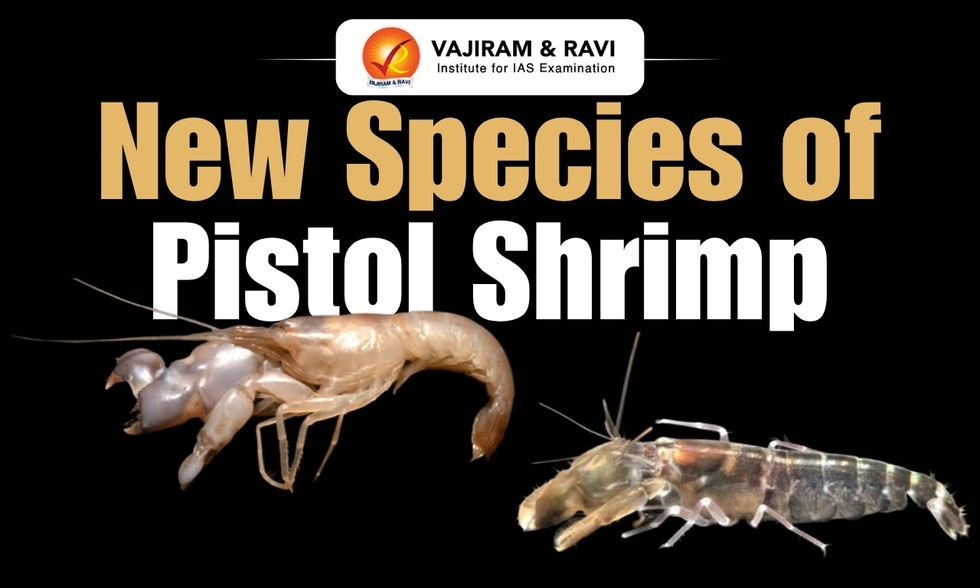
About Alpheus vembanadi and Alpheus hari:
- They are two new species of pistol shrimp.
- They were discovered in the Kochi backwaters of Kerala. The specimens were collected from gillnets, a traditional fishing method used in the backwaters.
- The first species, Alpheus vembanadi, has been named after the Vembanad backwaters.
- It is found in the Kochi backwaters throughout the year and can survive in waters with salinity levels of up to 31 parts per thousand (ppt).
- The second species, Alpheus hari, was named in honour of Dr. M. Harikrishnan, Senior Professor at CUSAT’s School of Industrial Fisheries.
- The species has a notable ability to tolerate changes in salinity.
- Researchers found it in waters with very low salinity, while laboratory studies showed that it can also survive in freshwater.
Key Facts about Pistol Shrimp:
- Pistol shrimp, also known as snapping shrimp, are a crustacean in the family Alpheidae.
- There are hundreds of species found all over the world, but most species are found in reefs and seagrass beds in temperate and tropical regions.
- They have one small claw called a pincer and a much larger claw-like snapper.
- Some shrimps have snappers that are bigger than half its body.
- The snapper is the shrimp’s weapon for killing or stunning prey.
- However, they don’t grab or choke prey the way a crab does. Instead, the snapper has a complex mechanism that gives it much more power.
- By rapidly snapping the snapper shut, the shrimp creates a cavitation bubble that collapses with a loud snapping sound.
- This snap can stun or even kill small prey, which the shrimp then consumes.