Optical Tweezers:
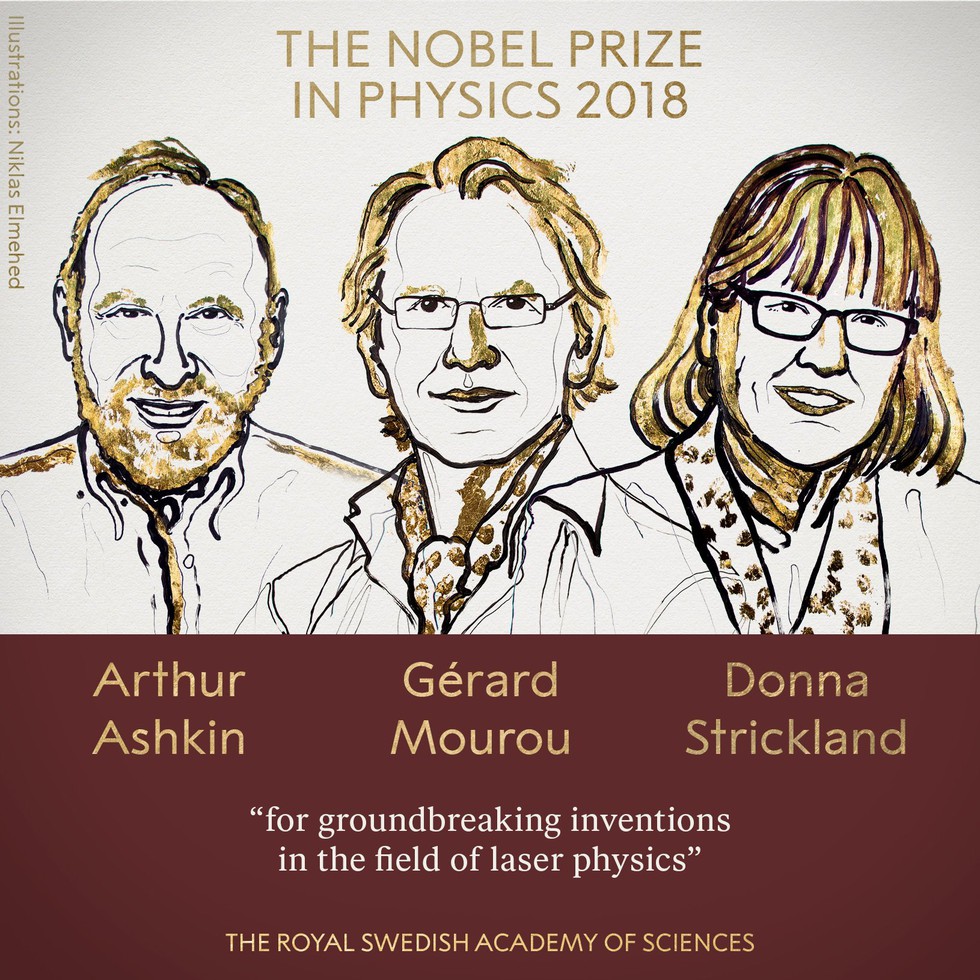
- Arthur Ashkin of U.S. has been awarded the Prize for his invention of “optical tweezers” that grab particles, atoms, viruses and other living cells with their laser beam fingers.
- Optical tweezers are scientific instruments that use a highly focused laser beam to provide an attractive or repulsive force (depending on the relative refractive index between particle and surrounding medium) to physically hold and move microscopic objects similar to tweezers.
- Optical tweezers have been particularly successful in studying a variety of biological systems in recent years. A major breakthrough came in 1987 when Mr. Ashkin used the tweezers to capture living bacteria without harming them.
- Ashkin is the oldest winner of a Nobel prize, beating out American Leonid Hurwicz who was 90 when he won the 2007 Economics Prize.
Chirped Pulse amplification (CPA):
- Gerard Mourou (of France) and Donna Strickland (of Canada) have been awarded for helping develop a method to generate “ultra-short optical pulses”, the shortest and most intense laser pulses ever created. Their technique is now used in corrective eye surgery.
- Laser light can be emitted in short pulses, but they can’t be amplified beyond a point without destroying the material. Mourou and Strickland’s technique known as Chirped Pulse Amplification (CPA), helped solved this problem.
- Donna Strickland (of Canada) is third woman to win the Nobel Prize in Physics, after Maria Goeppert-Mayer and Marie Curie.