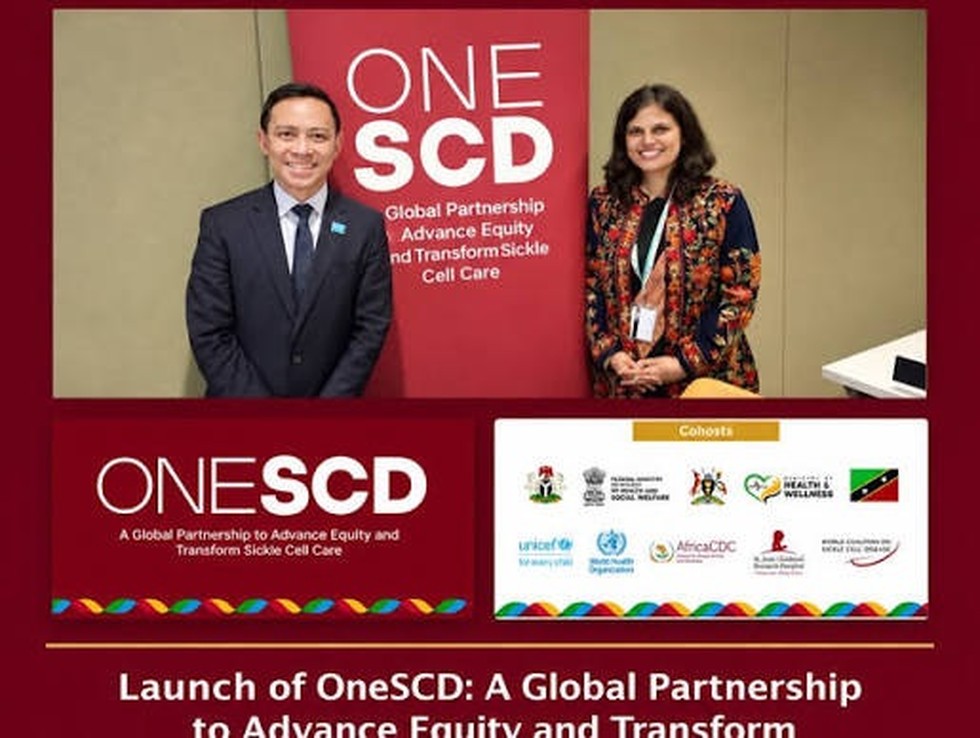
About OneSCD:
- It is a global partnership to advance equity and transform Sickle Cell Care.
- It is a multilateral coordination mechanism designed to strengthen and support existing country led Sickle Cell Disease (SCD) programs and help scale proven approaches to care.
- Hosted By: It was hosted the Government of the Federal Republic of Nigeria and co-organized with UNICEF, WHO, Africa CDC, the World Coalition on Sickle Cell Disease, and St. Jude Children’s Research Hospital.
- It will bring together government leaders, UN agencies, health experts, civil society, and people with lived experience.
- The partnership focuses on strengthening international cooperation and improving access to prevention, diagnosis, treatment and continuing care for people affected by Sickle Cell Disease.
Key Facts about Sickle Cell Disease
- It is a group of inherited blood cell disorders that affect hemoglobin, the molecule in red blood cells (RBCs) that delivers oxygen to cells throughout the body.
- The most common and severe type of SCD is sickle cell anemia.
- How Does it Affect Blood Flow?
- Normally, RBCs are disc-shaped and flexible enough to move easily through the blood vessels.
- People with SCD have atypical hemoglobin molecules called hemoglobin S, which can distort RBCs into a sickle, or crescent, shape.
- When RBCs sickle, they do not bend or move easily and can block blood flow to the rest of the body.
- The sickle-shaped cells can also stick to vessel walls, causing a blockage that slows or stops the flow of blood.
- Causes: The cause of SCD is a defective gene, called a sickle cell gene.
- Treatments: A bone marrow transplant (stem cell transplant) can cure SCD.
- Gene therapy is also being explored as another potential cure.