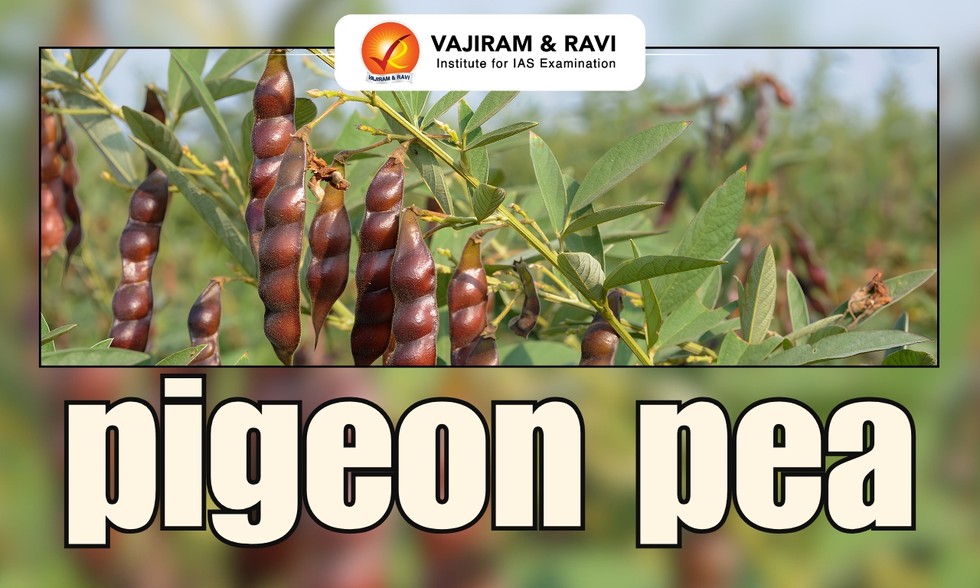
Recently, the Indian Council of Agricultural Research (ICAR) has developed India's first fully annotated telomere-to-telomere (T2T) reference genome of pigeonpea (Cajanus cajan L. Millsp.) variety 'Asha'.
About Pigeon pea:
It is popularly known as ‘Arhar’ or ‘Tur’.
It is one of India's most important pulse crops and a major source of dietary protein.
It is a legume crop and protein-rich food which is primarily consumed as dal in India.
It is predominantly a crop of tropical areas mainly cultivated in semi-arid regions of India.
Required Climatic conditions:
Rain: It requires 600-650mm of annual rainfall along with moist conditions for the initial eight weeks and dry conditions during its flowering and pod development phase.
Temperature: It can be grown with a temperature ranging from 26 to 30 degree Celsius in the rainy season and 17to 22 degree Celsius in the post rainy (November to March) season.
Soil: It can be grown on all types of soil, however, sandy loam or loam soil is most suitable for its cultivation.
It is very sensitive to low radiation at pod development, therefore flowering during the monsoon and cloudy weather, leads to poor pod formation.
It is commonly intercropped with a wide range of crops.
Diseases: The important diseases of Pigeon pea are Wilt, Sterility mosaic disease, Phytophthora blight, Alternaria blight and Powdery mildew etc.
Health benefits: It has low glycaemic index and is rich in thiamine, riboflavin, niacin, vitamin B-6, folate, vitamin A, calcium, zinc, iron and magnesium
Major Pigeon pea producing states: Uttar Pradesh, Madhya Pradesh, West Bengal, Bihar and Jharkhand.
Dear Student,
You have still not entered your mailing address. Please enter the address where all the study materials will be sent to you. (If applicable).