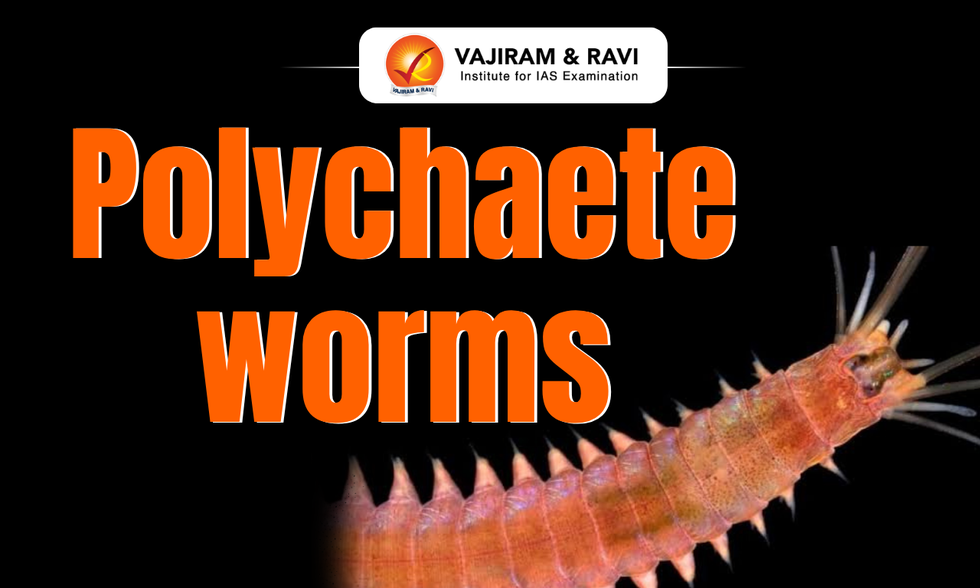
In recent years, the booming shrimp aquaculture industry has driven large-scale harvesting of wild polychaete worms.
About Polychaete worms:
Polychaete worms are a diverse group of marine annelids.
They are also known as bristle worms and are among the most diverse groups of marine invertebrates on Earth.
Polychaeta means “having much hair”, refers to the bristles on the fleshy, leg-like protrusions on their body.
Habitat: They occur in almost all marine habitats, from estuaries, mangroves, sandy shores, coral reefs, and seagrass beds to the continental shelf and deeper waters.
Characteristics:
They have parapodia (small leg-like structures) for crawling, swimming and burrowing.
Each segment has a pair of parapodia with chaetae (bristles).
Their bodies consist of circular layer of muscle around a coelom (fluid-filled space).
Many have tentacles for feeding or feather-like branchial radioles for feeding and breathing.
Reproduction: Some reproduce sexually, others asexually. Some species are hermaphrodites, which mean they have both male and female reproductive organs.
Their high ecological adaptability and sensitivity to environmental stresses also makes them great bioindicators of ecological health.
Ecological role: They are detritivores (that consume detritus to obtain nutrients) and play a major role in the breakdown of organic matter, oxygen transport, and its redistribution.
Dear Student,
You have still not entered your mailing address. Please enter the address where all the study materials will be sent to you. (If applicable).