
Pyrene
A novel material developed by scientists through incorporating metallic nanowires into metal–organic framework (MOF), can harness a broad range of light wavelengths to efficiently degrade environmental pollutants like pyrene.
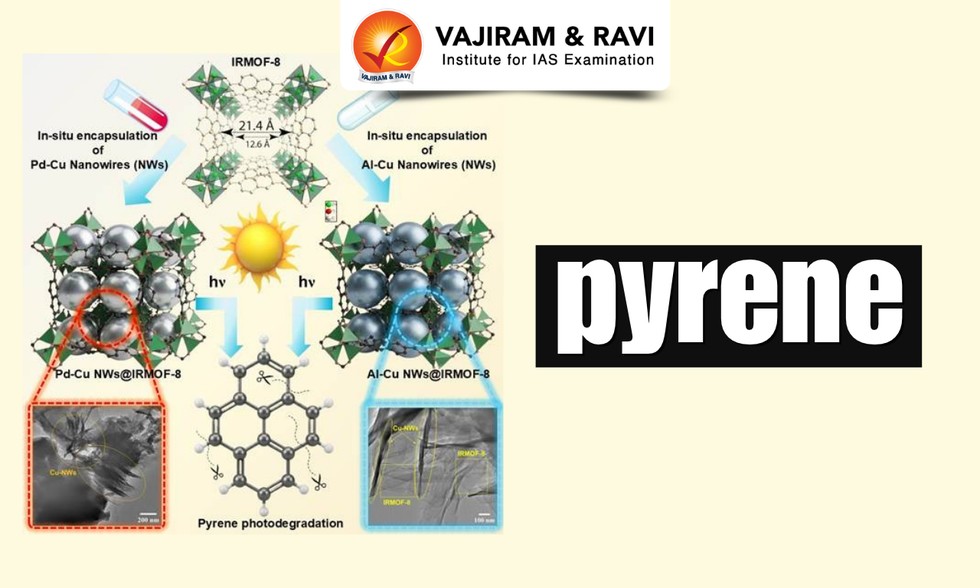
About Pyrene:
- It is a persistent polycyclic aromatic hydrocarbon (PAH).
- It belongs to the highly toxic class of PAHs, with carcinogenic and mutagenic properties.
- Structure: It is an ortho- and peri-fused polycyclic arene consisting of four fused benzene rings, resulting in a flat aromatic system.
- Pyrene is formed from incomplete combustion of organic chemicals.
- It is primarily found in the distillate of coal tar pitch.
- Properties:
- It is a pale yellow crystalline powder that possesses an aromatic odor, is flammable, insoluble in water, and readily soluble in ethanol and diethyl ether.
- It can undergo electrophilic substitution reactions such as halogenation, nitration, and sulfonatio
- Pyrene has excellent properties such as thermal stability, high fluorescence quantum efficiency and high carrier mobility.
- Applications:
- Pyrene serves as a raw material for organic synthesis.
- It can be oxidized to produce 1,4,5,8-naphthalenetetracarboxylic acid, which is used in the production of dyes, synthetic resins, disperse dyes, and engineering plastics.
- Impact on Environment: It gets lodged into the environmental matrices like soil, water and atmosphere, resulting in widespread environmental pollution.