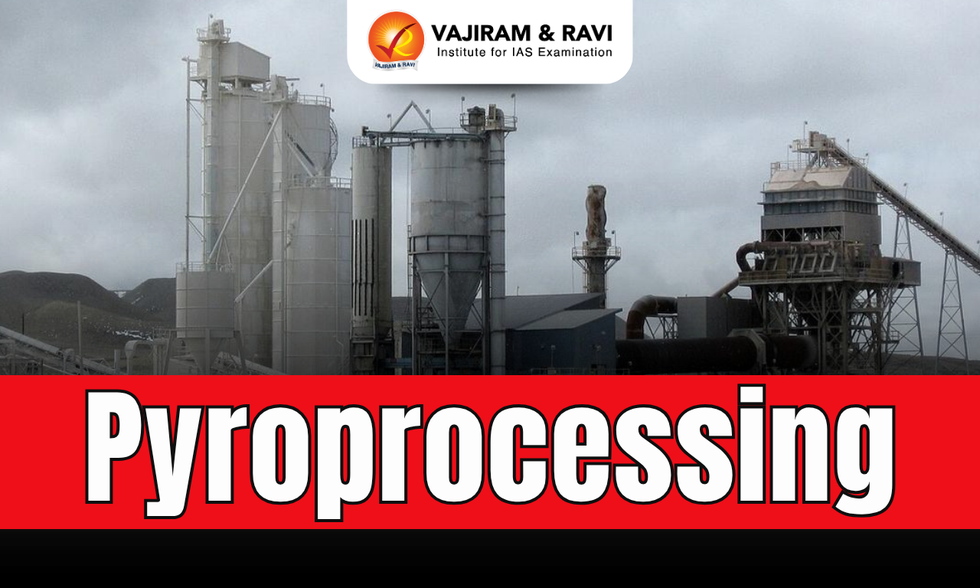
Pyroprocessing is being used in many sectors across the globe.
About Pyroprocessing:
It is a way to change a solid material physically or chemically using high temperature.
It is a dry process and very energy-intensive. Three sectors that use it most are cement-making, metallurgy, and nuclear power.
Applications of Pyroprocessing:
Cement Making:
This sector uses pyroprocessing the most and it involves
First, finely ground limestone, clay and iron — the raw materials — are fed into a rotary kiln.
As the temperature increases to 900° C, the limestone loses its carbon dioxide, and at around 1,450° C, the mix partly melts to form marble-sized nodules called clinker.
The clinker is then ground to produce cement.
Metallurgy Sector:
Pyroprocessing is used to extract metalsfrom their ores in multiple stages.
For example, sulphide ores are heated in air, or roasted, to convert them into metal oxides, like zinc sulphide.
Smelting melts an ore to separate the metal from waste impurities called slag.
Nuclear industry:
It uses pyroprocessing to reprocess spent nuclear fuel.
First, used nuclear fuel is broken up into pieces and placed in a salt bath — usually a mixture of lithium and potassium chlorides at 500° C or more.
Then, an electric current is passed through the salt bath, causing different elements to become separated depending on their electrochemical properties.
Operators then recover the elements of interest in separate streams.
Dear Student,
You have still not entered your mailing address. Please enter the address where all the study materials will be sent to you. (If applicable).