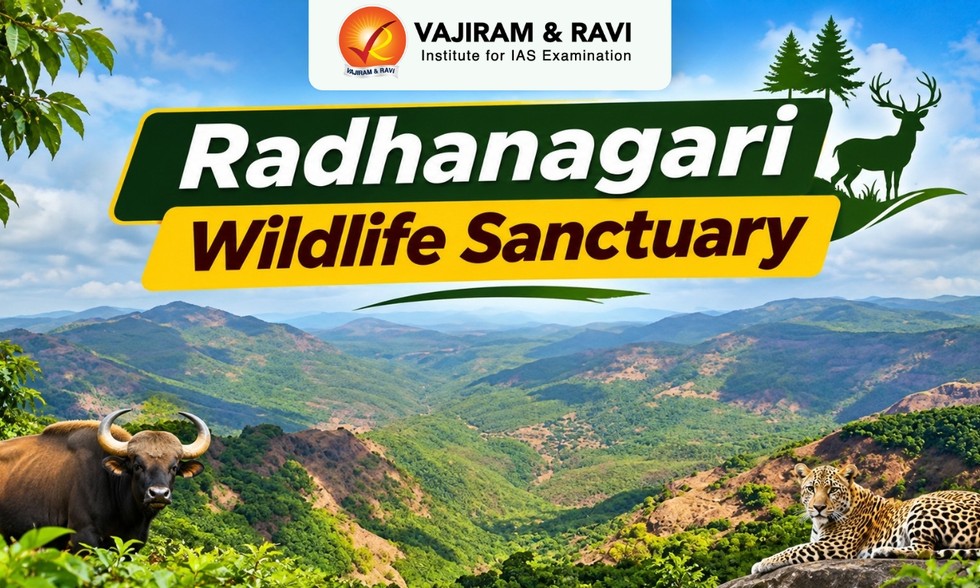
About Radhanagari Wildlife Sanctuary:
- It is located in Maharashtra.
- Nestled in the southern end of the Sahyadri hills in the Western Ghats, it was the former hunting ground of the Maharaja of Kolhapur.
- It was declared as a wildlife sanctuary in 1958 and is the first declared wildlife sanctuary in Maharashtra.
- It was specially created for the conservation of the Indian bison (Gaur).
- The sanctuary is also called ‘Dajipur Wildlife Sanctuary’ and ‘Bison Sanctuary’.
- The rivers that flow across the sanctuary are Bhogavati, Kallamma, Dudhganga, Dirba, and Tulshi, which then join the Krishna River.
- At its heart lies the scenic Radhanagari Dam on the Bhogawati River, which plays a vital role in maintaining the forest ecosystem.
- Flora:
- It contains tropical evergreen forests typical of the northern Western Ghats.
- The main flora found here are Ain, Anjani, Amba, Awala, Bhoma, Bibba, Chandala, Gela, Hirda, Jambul, Jambha, Kinjal, Kumbha, Katak, Nana, Pisa, Umbar, etc.
- Fauna:
- The Indian Bison is the flagship species of the area.
- Besides, one can also spot leopards, sloth bears, tigers, barking deer, mouse deer, sambar, giant squirrels, and wild dogs.
- It is also designated as an Important Bird Area by BirdLife International.
- It is home to the rare and globally threatened Nilgiri wood-pigeon, along with Ceylon frogmouth, yellow-browed bulbul, dusky eagle-owl, Malabar grey hornbill, and great pied hornbill, and one of India's most admired songbirds, the Malabar whistling thrush.