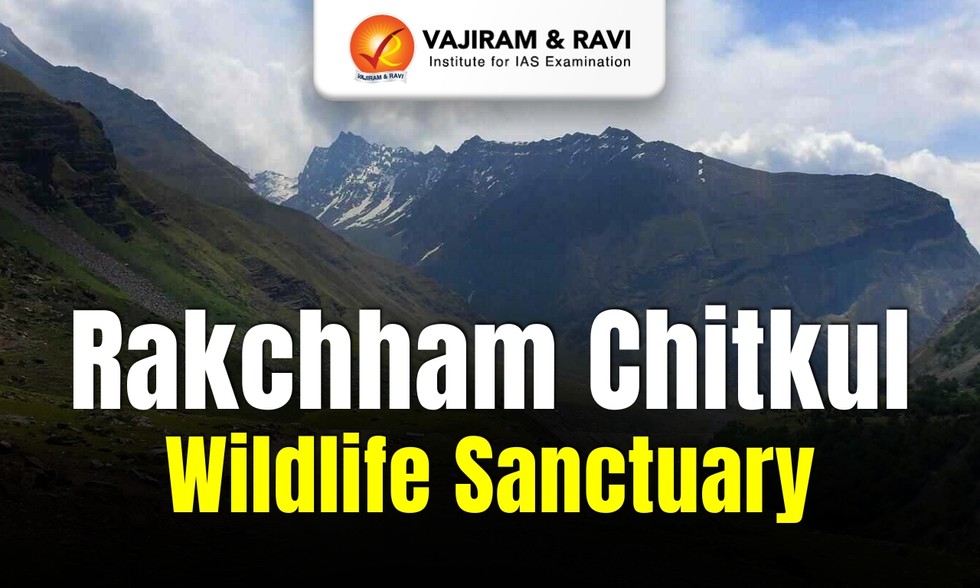
About Rakchham Chitkul Wildlife Sanctuary:
- It is located in the Kinnaur district of Himachal Pradesh.
- The sanctuary is also referred to as `Sangla Wildlife Sanctuary`.
- The perilous Lamkhanga Pass is one of the many trekking routes that pass through this sanctuary.
- This pass connects the Himachal Pradesh province of Kinnaur to the Uttarakhand region of Gangotri.
- Unlike the climate of other sanctuaries in Himachal Pradesh, the sanctuary is located in a dry zone; hence it does not experience monsoons.
- Vegetation: Sub-Alpine Forests, Dry Broadleaf and Coniferous Forests, Dry Temperate Forests and Dry Alpine Scrubs and Pastures.
- Flora: Rhododendrons, oak trees, pine trees, and medicinal herbs.
- Fauna: It is also home to various species of wildlife, such as snow leopards, Himalayan black bears, musk deer, and numerous bird species.
Key Facts about Himalayan Brown Bear:
- It is the largest mammal found in the high-altitude regions of the Himalayas.
- It is one of the most ancient brown bear lineages.
- Scientific Name: Ursus arctos isabellinus
- It is also known as the “Himalayan Red Bear” and the “Isabelline Bear”. It is known as Denmo in the Ladakhi
- It is believed by some that the bear’s ability to walk upright probably gave rise to the legend of the Yeti or “Abominable Snowman.”
- Distribution:
- They are found in the northwestern and central Himalayas, including Pakistan, India, Nepal, the Tibetan Autonomous Region of China, and Bhutan.
- They are found above the timberline, between 3,000 and 5,500 meters above sea level.
- In India, this species exists in small isolated populations in the fragmented alpine and subalpine habitats of Jammu and Kashmir, Himachal Pradesh, and Uttarakhand.
- Features:
- Males are larger than females, with an average length of 1.9 m and weight of 135 kg, in comparison to the female averages of 1.6 m and 70 kg.
- It has thick fur, which is most often sandy or reddish-brown in colour.
- Food: Omnivorous, eating grasses, roots, bulbs, and other plants, insects, and small mammals such as marmots, pikas, and voles.
- They hibernate in dens during the winter.
- Conservation Status:
- IUCN Red List: Critically Endangered