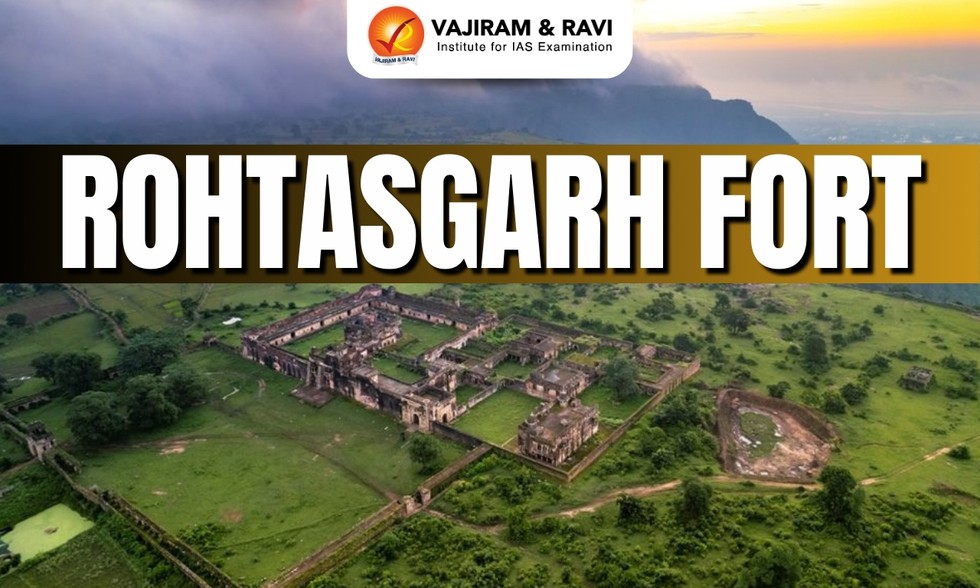
An under-construction ropeway being built to improve access to the historic Rohtasgarh Fort in Bihar’s Rohtas district collapsed during a trial run recently.
About Rohtasgarh Fort:
The Rohtasgarh Fort, also known as Rohtas Fort, is located in the city of Rohtas on the banks of the Sone River in Bihar.
It is one of the largest forts in India.
It is situated on the top of a hill and is one of the most ancient forts in India, known for its large defensive walls and impressive architecture.
The fort complex includes gates, palaces, temples, and reservoirs, showcasing Indo-Afghan architectural styles.
History:
The fort was built by the ruler of the Solar dynasty, Raja Harishchandra. It was named after his son, Rohitashva.
Inscriptions at the fort suggest that the fort has passed through the hands of several empires, including the Hindu Shahis, the Ghurids, the Mughals, and eventually the British Raj.
Sher Shah Suri conquered the fort in 1539 after losing the Fort of Chunar to Humayun, a Mughal ruler.
The fort, in its present form, was significantly strengthened by Sher Shah Suri.
The Jama Masjid,built to the west of the fort by Haibat Khan (a close aide of Sher Shah), is made of white sandstone.
Akbar acquired the fort in 1587 and gave it to Raja Maan Singh, who was appointed the Governor of Bihar.
In the 16th century, Jahangir’s son, Prince Khurram, sought refuge at the fort.
In the 17th century, Mir Kasim, the Nawab of Bengal, sought refuge at the fort after losing a battle against the British.
However, the fort was handed over to British Captain Goddard by the Diwan of Rohtas, and the fort’s defenses were destroyed.
The fort remained abandoned until 1857, during the First War of Independence, when Babu Kunwar Singh’s younger brother, Amar Singh, sought refuge t
Finally, the British recaptured Rohtasgarh and soon abandoned it.
Dear Student,
You have still not entered your mailing address. Please enter the address where all the study materials will be sent to you. (If applicable).