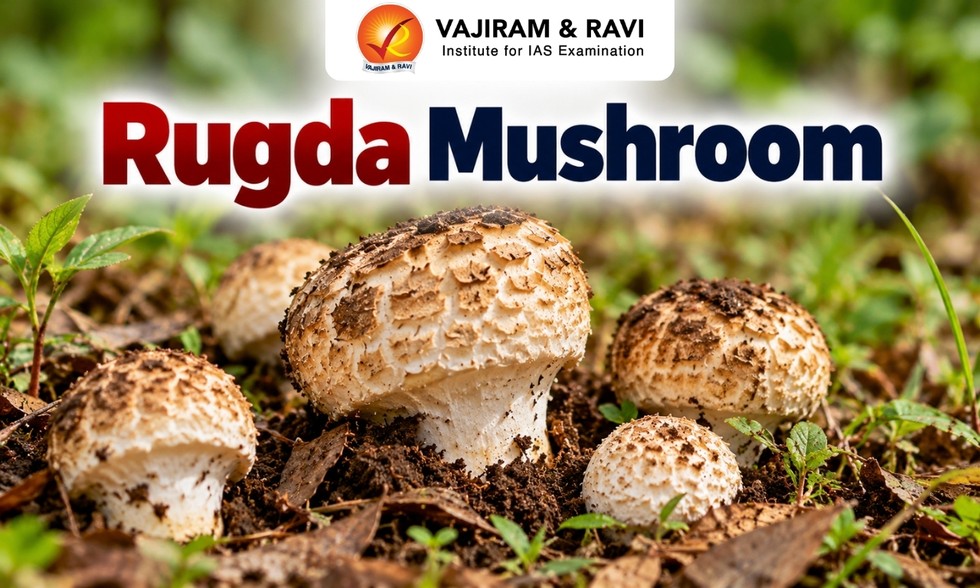
Rugda mushroom which is an important non-timber forest produce providing seasonal income for many tribal households in forested villages of Jharkhand.
About Rugda Mushroom:
It is a wild, edible subterranean fungus.
It is scientifically known as Astraeus hygrometricus or Astraeus asiaticus.
It is commonly foraged by tribal communities in eastern and central India.
It is highly prized across the Chhotanagpur Plateau, particularly in Jharkhand, Odisha, Chhattisgarh, and West Bengal
It appears beneath the forest floorafter the first monsoon showers and is hand-foraged for only a few weeks each year.
It survives in a natural partnership with the roots of sal trees, exchanging nutrients through an underground fungal network. Scientists call this an ectomycorrhizal relationship.
Ideal Condition for Growth:
It relies heavily on the monsoon for growth.
Ideal conditions include high rainfall (around 350 cm), ample sunlight, and temperatures near 30°C.
The fallen Sal leaves decompose over time to form a nutrient-rich humus layer.
This layer is a dark, organic part of the soil that is high in moisture and essential nutrients, creating an environment that supports the healthy growth of these mushrooms.
Dear Student,
You have still not entered your mailing address. Please enter the address where all the study materials will be sent to you. (If applicable).