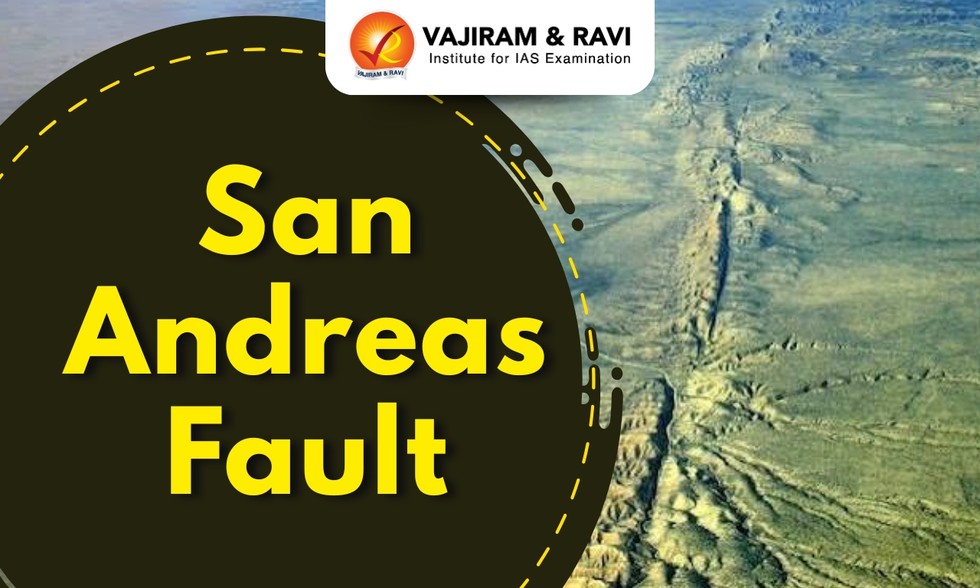
About San Andreas Fault:
- Location: It is a major continental transform boundary that is situated in the extreme western part of the continent of North America.
- It is believed that the San Andreas Fault started to form about 30 million years ago in the mid-Cenozoic Era.
- It forms the border between two principal tectonic plates: the North American Plate on the eastern side and the Pacific Plate on the western side.
- Geologists classify the San Andreas Fault as a “strike-slip fault”, as the Pacific Plate slides laterally over the North American Plate in a northward direction.
- It is one of the world’s largest and most extensively studied faults.
- The northward movement along the San Andreas Fault had led to the creation of the Baja Peninsula.
What is Strike-slip Fault?
- It occurs in an area where two plates are sliding past horizontally with little to no vertical movement.
- Strike-slip faults are found in California, the San Andreas Fault being the most famous, which has caused many powerful earthquakes.