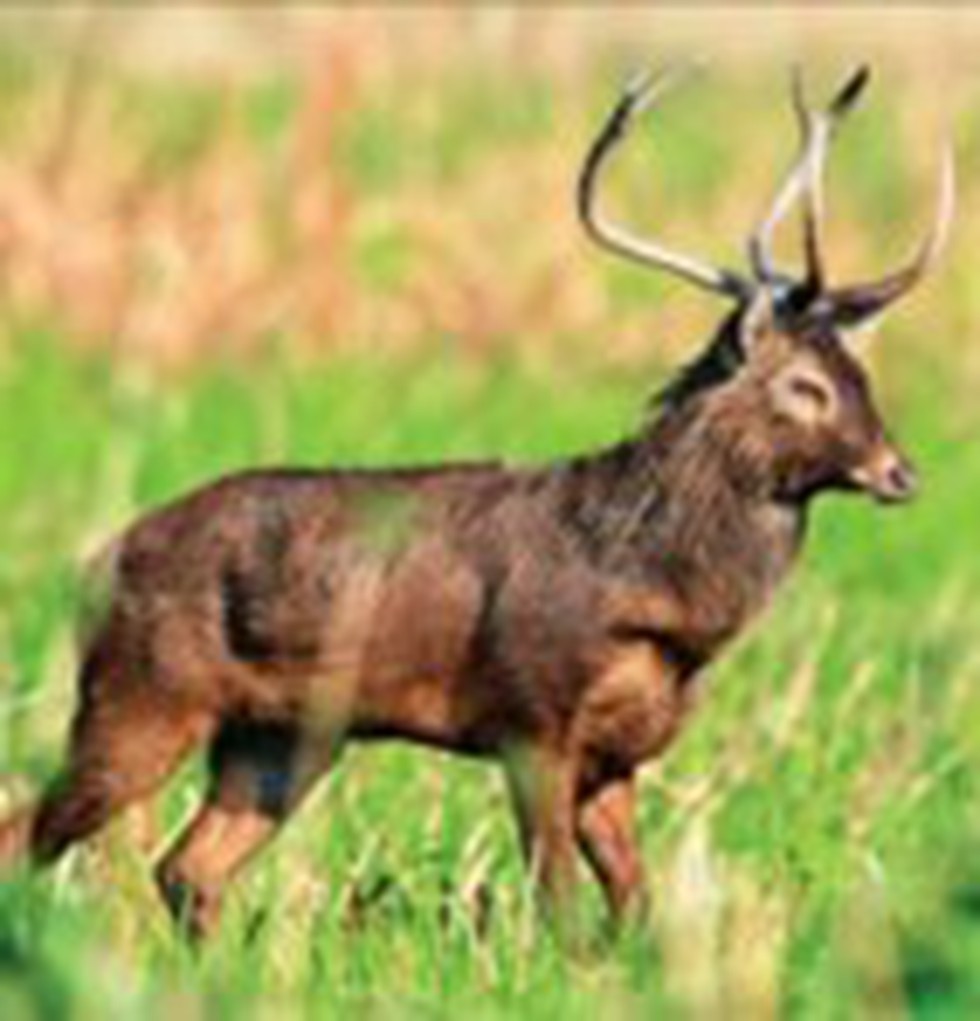
About Sangai:
- It is subspecies of Eld's deer that is endemic to Manipur.
- It also has immense cultural relevance to Manipur.
- Distribution: It is found only in Keibul Lamjao National Park; the largest single mass of phumdi is in Loktak Lake – in Manipur’s Bishnupur district.
- Appearance
- It is a medium-sized deer with uniquely distinctive antlers and extremely long brow tines, which form the main beam.
- The forward protruding beam appears to come out from the eyebrow, hence called the brow-antlered deer.
- It has a dark reddish-brown winter coat, which turns paler in summer.
- The deer walks on the hind surface of its pasterns with mincing hops over floating foliage and is hence also called the Dancing Deer.
- Conservation status
- IUCN: Critically Endangered
- The Wildlife (Protection) Act, 1972: Schedule-1
Key facts about Loktak Lake
- It is a freshwater lake in the state of Manipur.
- It is famous for unique floating islands called Phumdis with multiple plant species.
- The Keibul Lamjao National Park, located on the Loktak Lake is the last natural habitat of the “Sangai” the dancing deer of Manipur.
- It is regarded as among the most beautiful and ecologically diverse lakes in the Northeast.
- The lake is designated as a wetland of international importance under the Ramsar Convention.