
Santhal Tribe
In a significant ruling on the inheritance rights of women in the Santhal Adivasi community, the Jharkhand High Court held that daughters cannot be excluded from their father's property solely on the basis of traditional beliefs.
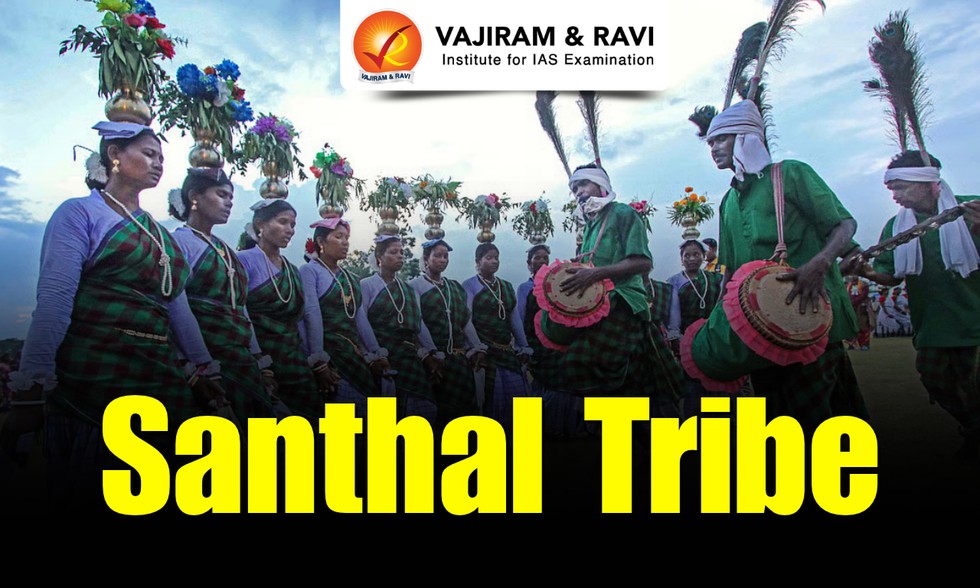
About Santhal Tribe:
- Santhals are the third largest scheduled tribe community in India after Gonds and Bhils.
- They mainly reside in the states of Bihar, Jharkhand, West Bengal, and Orissa.
- Language: They speak Santhali, a dialect of Kherwari, a Munda (Austroasiatic) language.
- Santhali, written in OI-Chiki script, is recognised as one of the scheduled languages in the Eighth Schedule to the Constitution.
- Belief System: They are nature worshippers and could be seen paying obeisance at Jaher (sacred groves) in their villages.
- Divorce is not a taboo in Santhal society. Either of the couple could divorce the other.
- Their traditional dress includes dhoti and gamuchha for men and a short-check saree, usually blue and green, for women, who generally put on tattoos.
- Occupation:
- Most Santhals are agriculturists, depending on their farmlands or forests.
- Seasonal forest collection is one of the important sources of their subsidiary income.
- Dance (enej) and music (sereng) are integral parts of the Santal life.
- Their homes, called Olah, have a particular three-colour patternon the outer walls. The bottom portion is painted with black soil, the middle with white, and the upper with red.
Source: Santhal custom cannot deny daughters' ancestral property rights without proof: Jharkhand HC