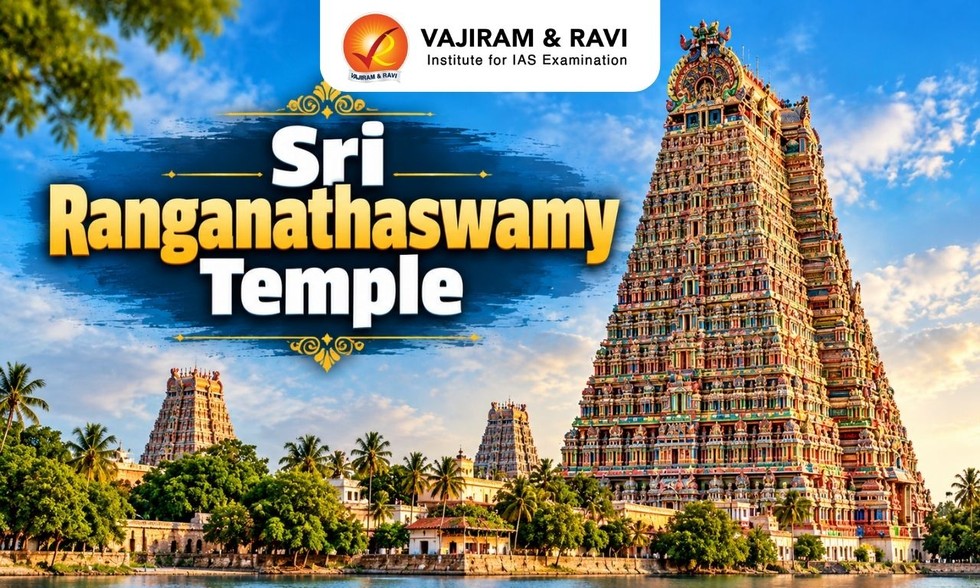
About Sri Ranganathaswamy Temple:
- It is a prominent Hindu temple situated at Srirangam near Trichy in Tamil Nadu.
- This temple lies on an islet formed by the twin rivers Cauvery and Coleroon.
- It is the biggest functioning Hindu temple in India and is often found ranked amongst the largest religious complexes of the world.
- This temple is dedicated to Ranganatha, a reclining form of Hindu deity, Lord Vishnu.
- It is regarded as the foremost among the 108 Divya Desams dedicated to Lord Vishnu.
- Though the temple has existed since the 2nd century BC, the archaeological inscriptions are available only from the 10th century CE.
- This temple underwent many changes during the rule of the Cholas, Cheras, Pandiyas, Hoysalas, Vijayanagar kings, and Nayaks of Madurai.
- In addition, influential Vaishnava leaders like Yamunacarya, Ramanujacarya, and Sudarsanacarya played pivotal roles in shaping the temple’s worship and its enduring legacy.
- Architecture:
- The entire temple complex is an example of Dravidian architecture.
- The temple is enclosed by seven concentric walls known as “Prakaram”, symbolizing the seven planetary systems in Vedic cosmology.
- Within these walls, there are twenty-one towering entrances, known as gopurams, each adorned with intricate sculptures and designs.
- The Rajagopuram is recognised as the tallest temple tower in Asia.
- The vimana over the sanctum of the temple is made up of gold.
- It also comprises a hall containing 1000 pillars. Intricate sculptures are the most attractive part of the hall. The Hall was built during the Vijayanagara period (1336-1565).
- Inside the temple, one can find inscriptions from the Chola dynasty, accompanied by tales of the Pandya, Hoysala, and Vijayanagara empires that once flourished alongside the Tiruchirappalli rule.
- A substantial part of Srirangam town resides within the periphery defined by the three outer walls of the temple complex.