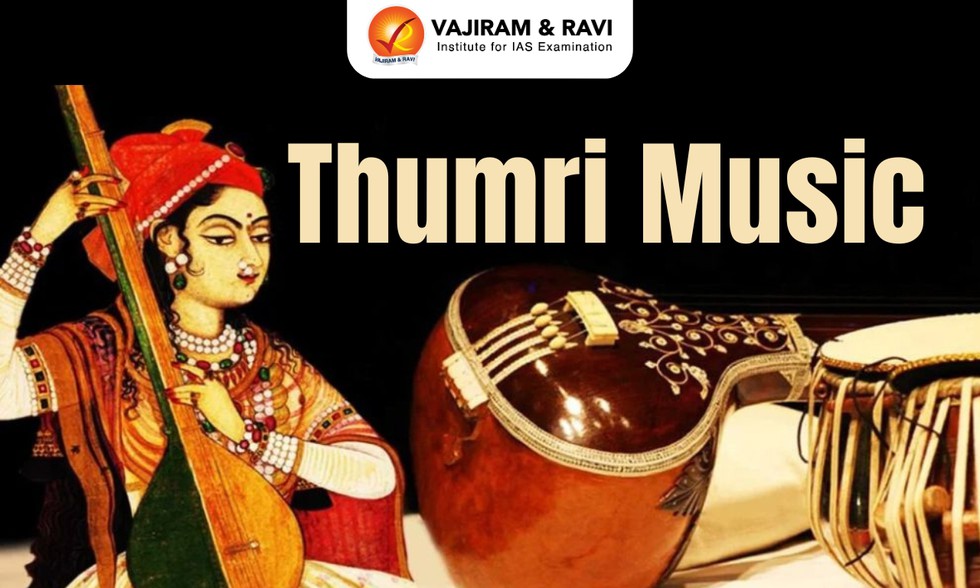
Recently, Thumri lost a towering voice with the demise of Pandit Chhannulal Mishra (1936–2025), Padma Vibhushan awardee and one of the last great exponents of the Purab Ang of Banaras Gharana.
About Thumri Music
Thumri is a semi-classical vocal form of Hindustani music, often called the “lyric of Indian classical music”.
It originated in Eastern Uttar Pradesh (mainly Lucknow and Benares) during the 18th century CE, developed by Sadiq Ali Shah.
Themes: Primarily about love, separation, and devotion, often centered on Radha-Krishna episodes.
Language: Usually sung in Braj Bhasha, Awadhi, and Hindi dialects, with touches of Urdu and Sanskrit.
Distinct Feature: Freedom in improvisation; emphasis on bhava (emotion) over strict adherence to raga grammar.
Associated Dance Form: Closely linked with Kathak, enhancing its narrative expression.
Influences: Draws from Hori, Kajri, Dadra, Jhoola, Chaiti, etc.
Types of Thumri
Purbi Thumri (Eastern/Slow tempo): More emotional and lyrical, usually associated with Banaras Gharana.
Punjabi Thumri (Fast tempo): Energetic, lively, linked with Patiala Gharana.
Dear Student,
You have still not entered your mailing address. Please enter the address where all the study materials will be sent to you. (If applicable).