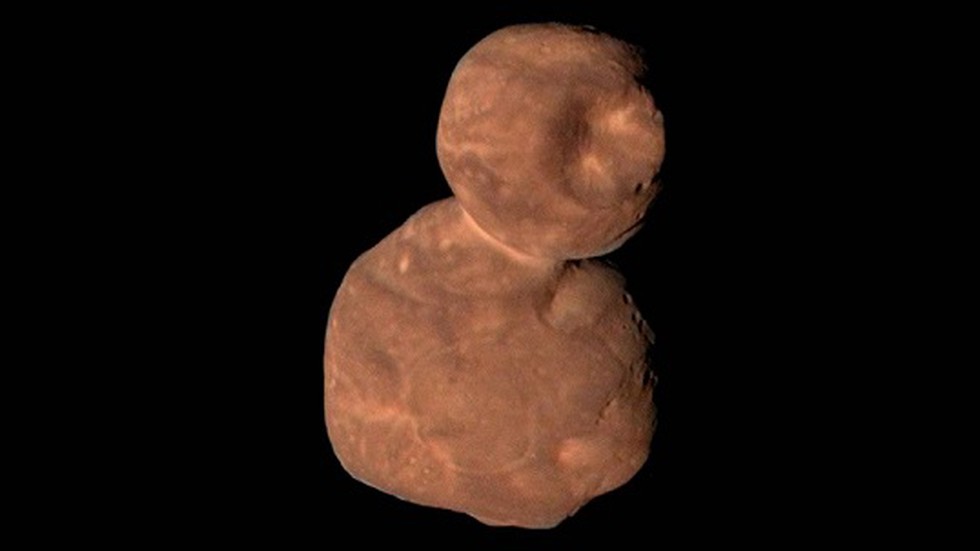
Researchers from NASA’s New Horizons Team have published a paper in Science analysing the Kuiper belt object ‘Ultima Thule’s’ shape and red colour.
About:
Location: Ultima Thule is a trans-Neptunian object located in the Kuiper belt.
Timeline:
It was discovered in 2014 by astronomers using the Hubble Space Telescope as part of a search for a Kuiper belt object for the New Horizons mission
With the New Horizons space probe's flyby on 1 January 2019, 2014 MU69 became the farthest object in the Solar System visited by a spacecraft.
Nomenclature: Its scientific name is (486958) 2014 MU69. It is nickname, Ultima Thule (a Greco-Latin term for a place beyond the known world) was chosen as part of a public competition in 2018.
Features of the object:
It is a contact binary 31 km long, composed of two joined bodies 19 km and 14 km across that are nicknamed "Ultima" and "Thule", respectively.
With an orbital period of 298 years and a low inclination and eccentricity, it is classified as a classical Kuiper belt object.
It is believed to be the most primitive object in the Solar System, both bodies being planetesimal aggregates of much smaller building blocks.
In color and composition, Ultima Thule resembles many other objects found in its area of the Kuiper Belt. It’s very red – redder even than Pluto. Its reddish hue is believed to be caused by modification of the organic materials on its surface.
There is evidence for methanol, water ice, and organic molecules on Ultima Thule’s surface – a mixture very different from most icy objects explored previously by spacecraft.
Dear Student,
You have still not entered your mailing address. Please enter the address where all the study materials will be sent to you. (If applicable).