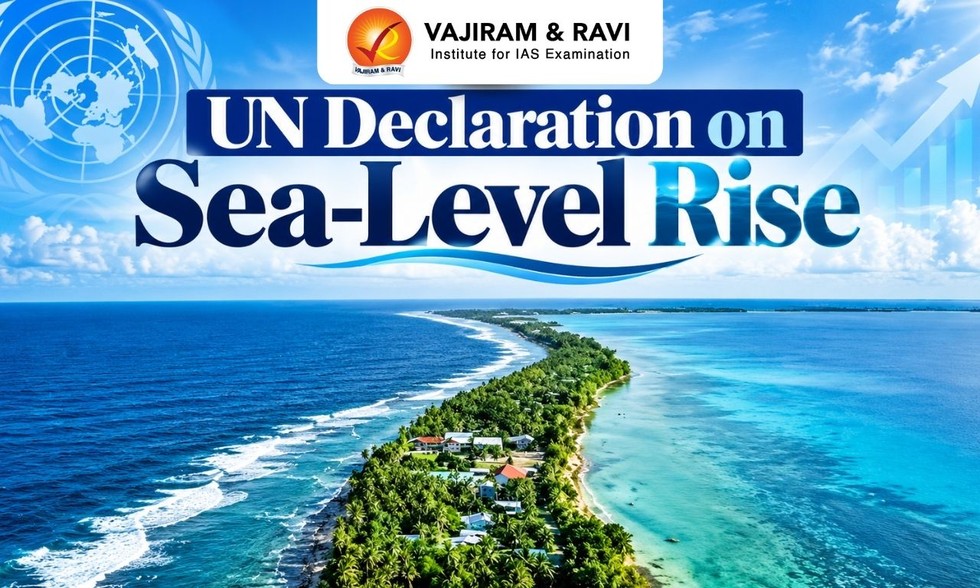
About UN Declaration on Sea-Level Rise:
- It was adopted by the United Nations General Assembly during a high-level plenary meeting on September 24, 2026.
- It is the UN’s first declaration on sea level rise.
- The declaration establishes a common international position on the legal and practical challenges posed by rising seas.
- Global mean sea level reached a record high in 2024, and its rate of rise has doubled, from1 millimeters per year in 1993-2002 to 4.7 millimeters per year in 2015-2024.
- Major Highlights of the Declaration:
- It affirms that countries threatened by rising oceans do not automatically lose their statehood if their territory becomes submerged.
- This means that the continued existence of a country under international law would not necessarily depend on its territory remaining above water.
- It supported the continued existence of such states’s sovereignty, rights, responsibilities, and UN membership.
- The issue is particularly relevant to small island developing States (SIDS), where rising seas can reduce habitable land and, in extreme cases, lead to the submergence of territory.
- It calls for stability in maritime zones despite physical changes to coastlines.
- It states that countries can maintain maritime zones established under the UN Convention on the Law of the Sea (UNCLOS) as sea levels rise, while retaining the right to update them.
- The issue arises because maritime zones are generally measured from coastal baselines.
- This is particularly important for island nations because maritime zones determine rights over ocean resources and activities.
- The declaration also addresses the wider threat that rising seas pose to coastal populations, infrastructure, and livelihoods.
- Without significant efforts to reduce emissions and adapt to rising seas, the risks facing coastal cities and communities could increase tenfold by 2100.
- The declaration calls for stronger anticipatory action, including multi-hazard early warning systems, and for climate-related risk assessments to be incorporated into planning and decision-making.
- It also urges greater international cooperation to provide financial, technical and policy support to developing countries, particularly SIDS and least developed countries.
- The declaration calls for increased funding to support local responses to sea level rise.
- It identifies nature-based measures, including the protection and restoration of mangroves, kelp forests, and seagrass meadows, as ways to help coastal communities adapt.
- The declaration also calls for sea level rise projections to be taken into account when planning, constructing, and maintaining critical coastal infrastructure.