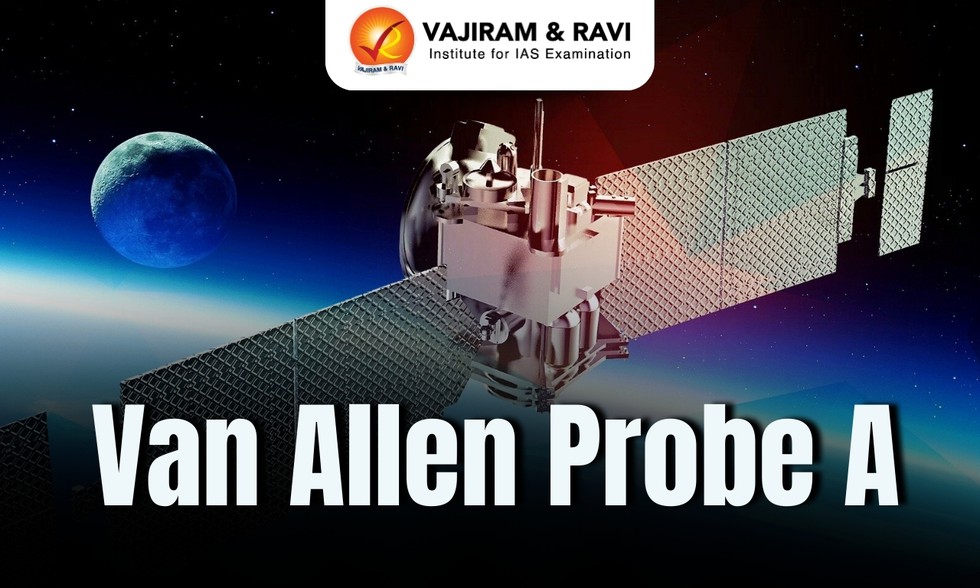
NASA's 600 kg Van Allen Probe A satellite is falling back to Earth, raising questions about whether people on the ground should be concerned.
About Van Allen Probe A:
NASA’s Van Allen Probes mission was the first mission to use two spacecraft in tandem to study Earth’s radiation belts.
Originally designed for a two-year mission, the Van Allen Probes A and Bgathered unprecedented data on Earth’s two permanent radiation belts — named for scientist James Van Allen — for almost seven years.
From 2012 to 2019, the spacecraft and its twin, Van Allen Probe B, flew through the Van Allen belts, rings of charged particles trapped by Earth’s magnetic field, to understand how particles were gained and lost.
The belts shield Earth from cosmic radiation, solar storms, and the constantly streaming solar wind that are harmful to humans and can damage technology, so understanding them is important.
By having two spacecraft with identical instruments, with one followed by the other along nearly the same path, researchers could measure changes that occur in Earth’s radiation belts over time and through space, providing insights into the physical dynamics of the radiation belts and changes that occur in this critical region of space.
NASA ended the mission after the two spacecraft ran out of fuel and were no longer able to orient themselves toward the Sun.
Dear Student,
You have still not entered your mailing address. Please enter the address where all the study materials will be sent to you. (If applicable).