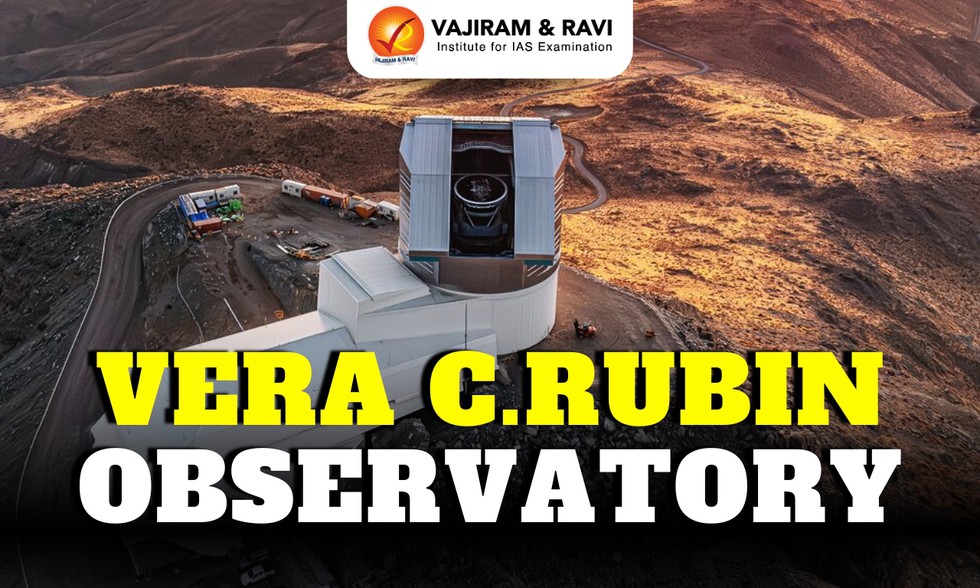
About Vera C.Rubin Observatory:
- It is located atop the Cerro Pachón mountain in the Chilean Andes, where dry air and dark skies provide one of the world's best observing locations.
- It is named after American astronomer Vera C. Rubin, who provided evidence about dark matter for the first time in the 1970s.
- It is jointly funded by theS. National Science Foundation and the U.S. Department of Energy's Office of Science.
- The observatory has four main scientific goals:
- Understand the nature of dark matter and dark energy.
- Create an inventory of the asteroids, comets, and other objects in the solar system.
- Map the Milky Way and help reconstruct its history.
- Explore objects — like exploding stars and black holes — that change position or brightness over time.
- The centrepiece of the observatory is the Simonyi Survey Telescope.
- It has the world’s largest digital camera.
- It is the fastest-slewing telescope in the world and takes just five seconds to move and settle from one target to another.
- This speed is due to the telescope’s compact structure (owing to the three-mirror design) and its mount, which floats on a film of oil.
- This observatory will provide comprehensive images of the night sky unlike anything astronomers have seen before.
- It will constantly scan the sky of the southern hemisphere, creating an ultra-wide, ultra-high-definition time-lapse record of the universe.
- The amount of data gathered by Rubin Observatory in its first year alone will be greater than that collected by all other optical observatories combined.
Key Facts about 2025 MN45:
- It is a newly discovered asteroid.
- It resides in the main asteroid belt between Mars and Jupiter.
- It completes one rotation every 1.88 minutes, making it "the fastest-spinning asteroid”.