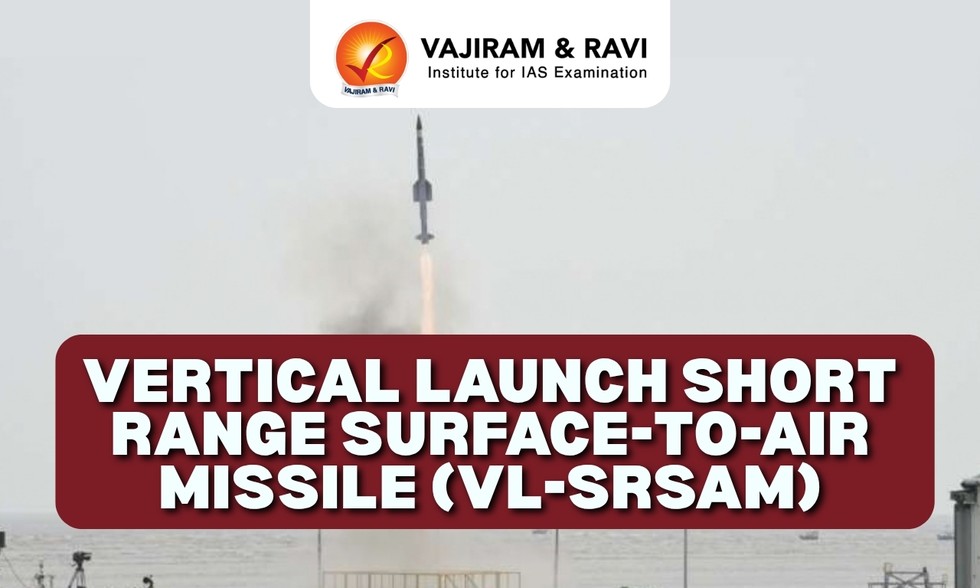
About Vertical Launch Short Range Surface-to-Air Missile (VL-SRSAM):
- It is an indigenously developed Short-Range Surface-to-Air Missile (SRSAM).
- It is designed and developed by the Defence Research & Development Organisation (DRDO) for the Indian Navy.
- It is primarily a ship-based weapon for neutralising various aerial threats at close ranges.
- Its primary mission is to intercept "sea-skimming" targets—missiles or drones that fly just above the ocean surface to evade early radar detection.
- Features:
- Powered by a solid-propellant motor, the missile can hit top speeds of Mach 4.
- It is capable of engaging threats up to an operational range of 80 km and an altitude of 16 km.
- The system's vertical launch capability is one of its most crucial operational advantages.
- By firing straight up from canister-based launchers before turning toward its target, the missile provides 360-degree coverage.
- This means a warship can intercept an incoming threat from any direction without needing to physically rotate the vessel or adjust a mechanical launcher.
- It relies on a state-of-the-art Multi-Function Radar (MFR).
- This Active Electronically Scanned Array (AESA) radar scans the sky, identifies threats, assigns priority, and feeds this critical data to the onboard Weapon Control Computer (WCC).
- As the missile approaches its target in the final phase of flight, an indigenous Radio Frequency (RF) seeker takes over to ensure pinpoint accuracy.