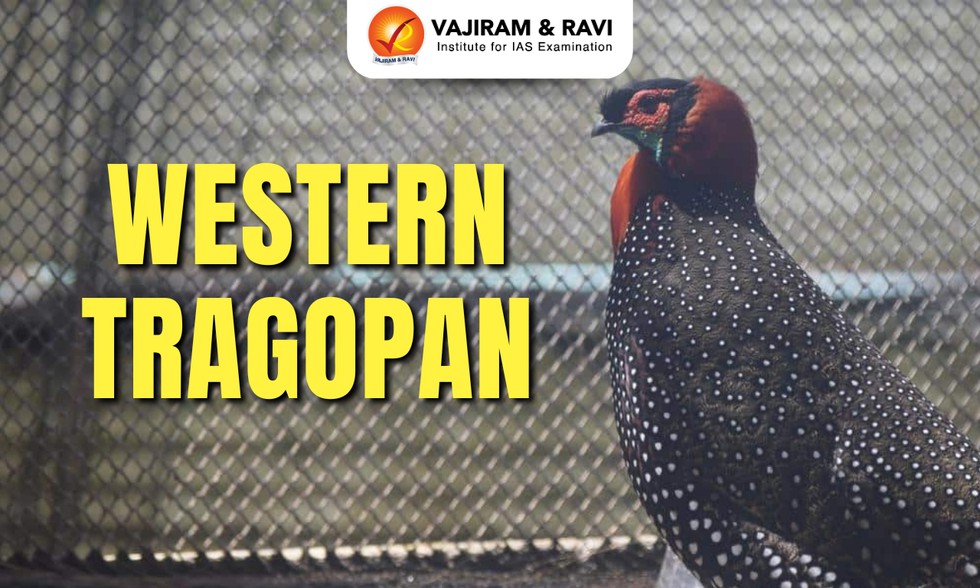
India’s western tragopan population steadied by captive breeding but human disturbance and habitat fragmentation continue to endanger its future.
About Western Tragopan:
It is also known as the western horned tragopan, is amongst the rarest of all living pheasants.
Due to its beautiful plumage and large size, this bird is locally known as ‘jujurana’ or ‘king of birds’
It is one of the rarest and most stunning pheasant species in the world.
These birds are shy and ground-dwelling and usually active during dawn and dusk.
It is the state bird of Himachal Pradesh.
Distribution: It is endemic to the northwest Himalaya, within a narrow range from Hazara in north Pakistan through Jammu and Kashmir and Himachal Pradesh, to the western part of Garhwal.
The upper part of Great Himalayan National Park’s (GHNP) forest zone holds the world’s largest known population of western tragopan.
Habitat: It prefers a habitat of ringal (dwarf) bamboo beneath dense forest.
Diet: It feeds mostly on leaves, shoots and seeds, but also consumes insects and other invertebrates.
Breeding: It breeds during May to June, laying 3–5 eggs in concealed nests on the forest floor.
Threats: Habitat loss, hunting pressure and anthropogenic disturbances which includes livestock grazing, minor forest produce collection like medicinal herbs etc.
Dear Student,
You have still not entered your mailing address. Please enter the address where all the study materials will be sent to you. (If applicable).