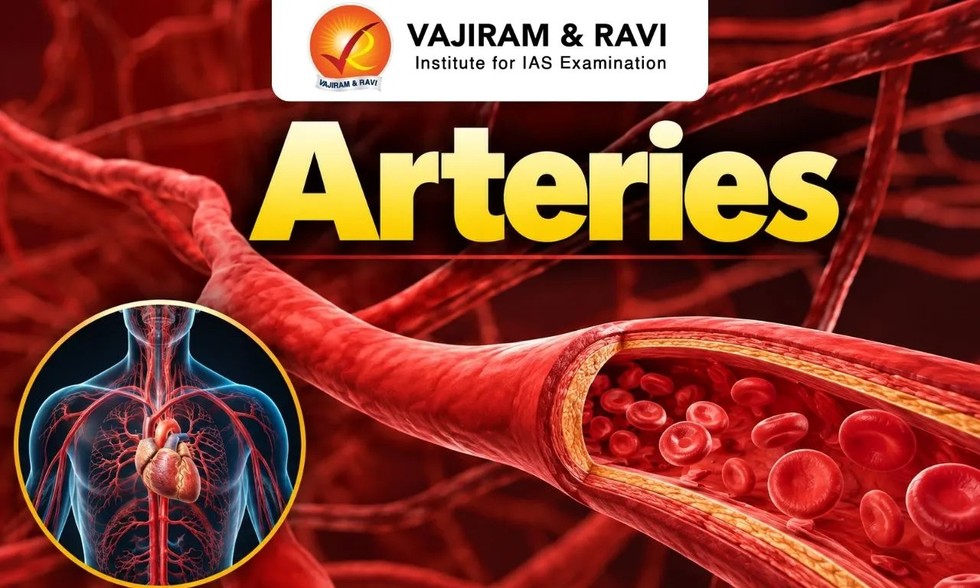
Pain in the legs while walking can be a warning sign that the arteries carrying blood to the legs are becoming blocked, a condition called Peripheral Artery Disease (PAD).
About Arteries:
Arteries are the blood vessels that bring oxygen-rich blood from heart to all of the body’s cells.
Arteries make up a major part of the circulatory system, with the veins and heart being the other main components.
They play a crucial role in distributing oxygen, nutrients, and hormones throughout the body.
The heart pumps oxygen-rich blood into the biggest artery in the body, the aorta.
This branches off into parts that feed smaller and smaller arteries, eventually reaching the entire body.
Arteries keep the body alive and healthy by delivering what the cells and tissues need.
Roughly 10% of the body’s blood is in the arteries at any point in time.
The arteries have three layers:
Tunica intima, or inner layer: Has tissue with elastic fiber.
Tunica media, or middle layer: This is mostly smooth muscle that lets arteries get tighter or more open as needed.
Tunica externa, or outer layer: Interacts with other tissues, including nerves that send commands to pull in or expand.
The two types of arteries are:
Elastic: Have more elastic tissue than muscular arteries and are located close to the heart. Examples: Aorta and pulmonary artery.
Muscular: Have more smooth muscle than elastic arteries. Examples: Femoral, radial, and brachial arteries.
Specific arteries provide blood to organs or certain parts of the body, such as:
Coronary arteries: Heart.
Carotid arteries: Brain, head, face and neck.
Vertebral arteries: Brain and spine.
Iliac arteries: Pelvis.
Femoral artery: Legs.
Subclavian arteries: Head, neck, and arms.
Celiac and mesenteric arteries: Digestive system.
Conditions that can harm your arteries include:
Atherosclerosis, a condition in which plaque builds up inside arteries.
Over time, plaque hardens and causes arteries to narrow.
That limits the flow of oxygen-rich blood to the body.
Aneurysm (a stretch or bulge in an artery that can break open).
Blood clot.
Coronary artery disease (atherosclerosis in your coronary arteries).
Carotid artery disease (atherosclerosis in your carotid artery).
High blood pressure.
High cholesterol.
Peripheral artery disease (PAD): A common condition in which narrowed arteries reduce blood flow to the arms or legs.
How are arteries different from veins?
Arteries:
Take oxygen-rich blood away from heart and distribute it to whole body.
Have strong, muscular walls that can handle the high pressure of blood the heart pumps out with each heartbeat.
Veins:
Bring blood back to the heart after body’s cells and tissues have taken the oxygen out of it. This is known as oxygen-poor blood or deoxygenated blood.
Have thinner walls because the pressure inside them isn’t as high as it is in arteries.
Have valves inside them to keep blood from moving in the wrong direction.
Dear Student,
You have still not entered your mailing address. Please enter the address where all the study materials will be sent to you. (If applicable).