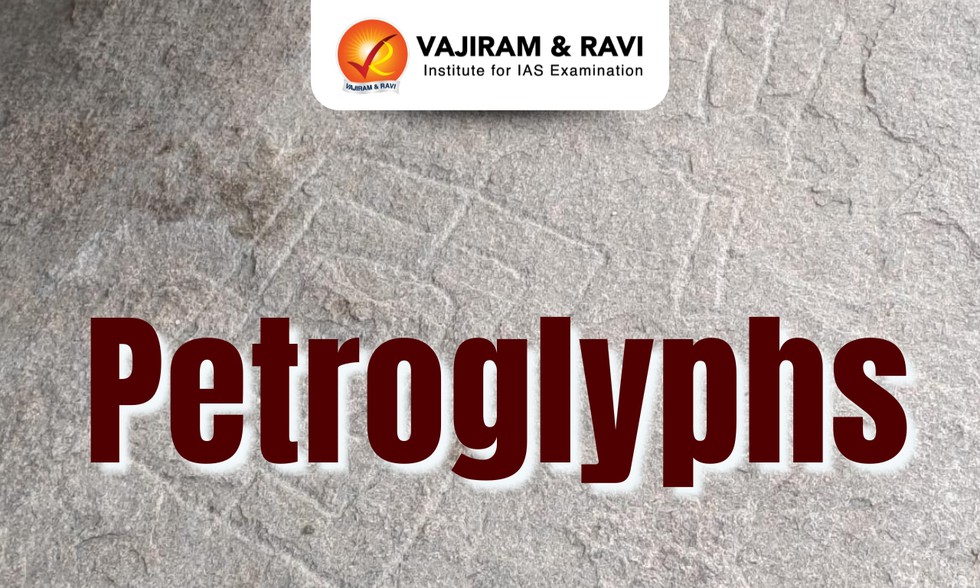
Researchers recently found two ancient rock carvings (petroglyphs) on a flat rock inside a rock shelter on a hill behind Beerappa Temple in Manchirevula, Telangana.
About Petroglyphs:
Petroglyphs (also known as rock engravings) are symbolic images sculpted or engraved on the surface of rocks by removing material from its surface layer with instruments of superior hardness.
The techniques used to create these images include pecking, incising, abrading, sculpting, polishing, drilling, and scratching.
These processes remove part of the rock and therefore are different from images simply painted or drawn on rock, which are called petrographs.
The word ‘’petroglyph’’ is derived from two Greek words, ‘’petros’’ meaning "stone," and ‘’glyphein’’ meaning "to carve."
Petroglyphs took two primary forms, as images either appear as scratches or deeper visible indentations on rock.
Petroglyphs are typically associated with prehistoric populations and can be found on every continent throughout the world, except Antarctica.
However, they are especially concentrated in Africa, South America, North America (mainly in the southwestern United States), Siberia, Australia, and Europe (Scandinavia, Spanish Galicia, Ireland and Italy).
Example of Petroglyph Site in India: Edakkal Caves in Wayanad, Kerala.
Significance of Petroglyphs:
They are among the earliest forms of art to have existed and are therefore considered the foundation of art.
Ancient peoples also used petroglyphs as a form of communication or writing.
For example, some petroglyphs clearly indicated the borders between tribal lands, and others were astronomical markers and maps.
Additionally, some petroglyphs served as musical instruments and were known as "rock gongs.”
Dear Student,
You have still not entered your mailing address. Please enter the address where all the study materials will be sent to you. (If applicable).