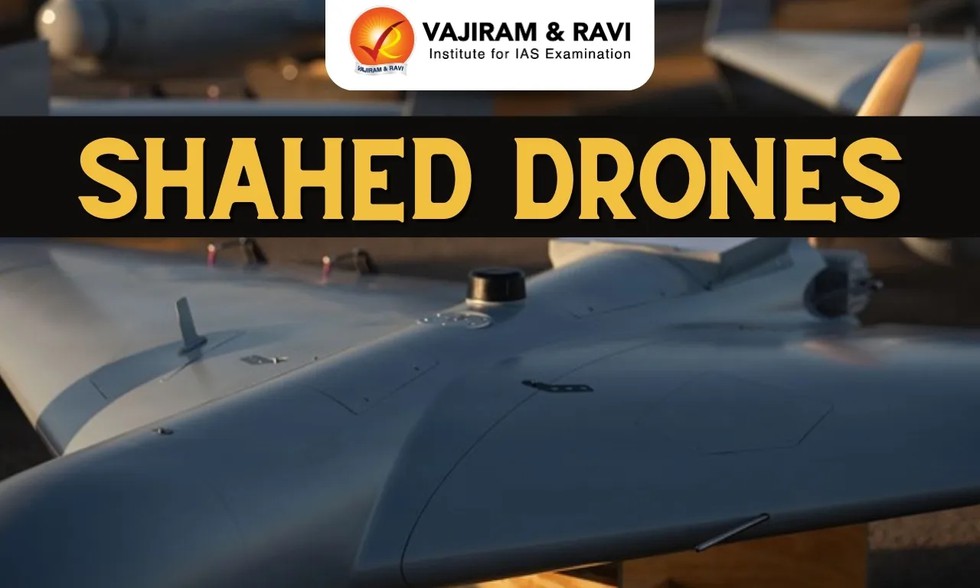
The United States recently raised serious concerns about the capabilities of Iran's Shahed attack drones.
About Shahed Drones:
Shahed drones are low-cost, one-way-attack unmanned aerial vehicles (UAVs) developed by Iran.
Often referred to as "kamikaze" or "suicide" drones, they function essentially as guided missiles that fly towards a pre-designated target and explode on impact.
Most widely used variants: Shahed-131 and Shahed-136
The low cost, low-altitude flight profile and self-sacrificial nature, has seen Shaheds labelled “the poor man’s cruise missile”.
Produced in large numbers, swarms of Shahed drones can overwhelm air defences by saturating them from multiple directions at once.
Features:
The Shahed-131 has a range of 700–900 km, while the Shahed-136 has the longer range, i.e., between 2,000 and 2,500 kilometres.
They are launched using a disposable rocket booster fitted to their underside. Shortly after launch, the booster is jettisoned, and a piston-driven engine takes over to provide propulsion.
They can be launched from both static rail mounts as well as vehicles.
For navigation, it uses a combination of civilian GPS/GLONASS and an Inertial Navigation System (INS) often pre-programmed with coordinates before launch.
They can be equipped with various warheads, including high-explosive fragmentation, thermobaric, and shrapnel-filled munitions, maximising damage to both personnel and equipment.
Dear Student,
You have still not entered your mailing address. Please enter the address where all the study materials will be sent to you. (If applicable).