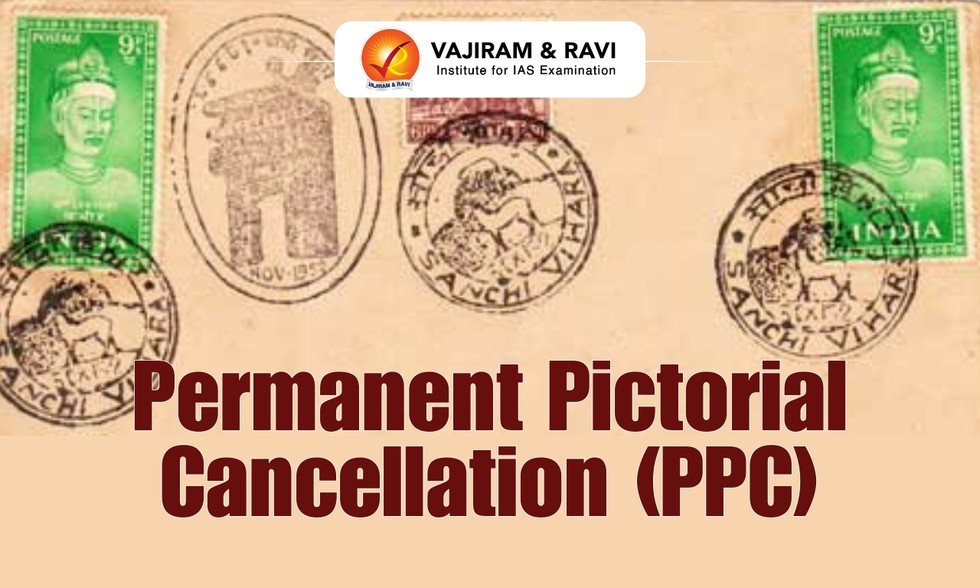
About Permanent Pictorial Cancellation (PPC):
- It is a postmark, which shows a replica/photo/design or a picture highlighting a tourist, religious, historical, or an important place or a living/non-living thing.
- PPCs give wide publicity to many places of historical, cultural, and tourist interest.
- It is one of the accepted methods of cancellation at post offices.
- They are provided at the post offices, which are located near such significant places.
- In PPC, the replica/photo/design or a picture is used as the cancellation seal.
- However, the regular features of the cancellation, the zip code, and date will be included in the seal.
- Unlike an ordinary cancellation used to cancel postage stamps on a particular day, a PPC is available for use on a permanent basis at a designated post office.
- The sender can have his mail sealed pictorially by postal staff by placing an oral request, provided a proper number of stamps are affixed on the mail.
- The pictorial cancellation can also be imprinted on postcards and inland letters. Once the pictorial cancellation is made, no normal cancellation is needed.
- It is of particular interest to philatelists (stamp collectors) because it provides a distinctive and lasting postal marking associated with a specific subject or location.
Key Facts about Sree Padmanabhaswamy Temple:
- It is a Hindu temple dedicated to Lord Vishnu located in Thiruvananthapuram (Trivandrum), Kerala.
- The name of the city of Thiruvananthapuram in Malayalam translates to “The City of Lord Ananta, ”referring to the deity of Padmanabhaswamy Temple.
- The earliest recorded mention of the temple is from the 8th or 9th century CE, although the temple is likely older.
- The temple was built and rebuilt over the centuries, most recently by Martanda Varma, king of Travancore, who in 1750 donated the kingdom to the deity.
- Architecture:
- It is a blend of Kerala and Dravidian styles of architecture.
- The idol of Vishnu is in the Anantha shayanam posture, the eternal yogic rest posture on his serpent Adisheshan.
- It has a seven-tier-high gopuram, which is decorated with delicate designs and carvings.
- Along with exquisite and intricate works on stone and bronze, the interior of the temple is adorned by exquisite paintings and murals, most of which are life-sized depictions of Lord Vishnu in the reclining posture, Lord Ganapati, Gaja Lakshmi, and Narasimha Swamy (half-lion, half-man incarnation of Lord Vishnu).
- The flag post of the temple (dhwaja stamba) is covered with gold-plated copper sheets and is about 80 ft high.
- The temple has around 3 million palm leaf manuscripts dating back to the 14th century
- Known as Mathilakam records, they contain the administrative and financial details of the temple town and Travancore kingdom spread over six centuries.
- In 2011 the temple was the subject of international news when an exploration of its vaults revealed a wealth of jewels, precious metals, and other treasures.
- It is also widely believed to be the world’s richest temple.